Some Observations on Ageing Effects in Bovine Skin
Abstract
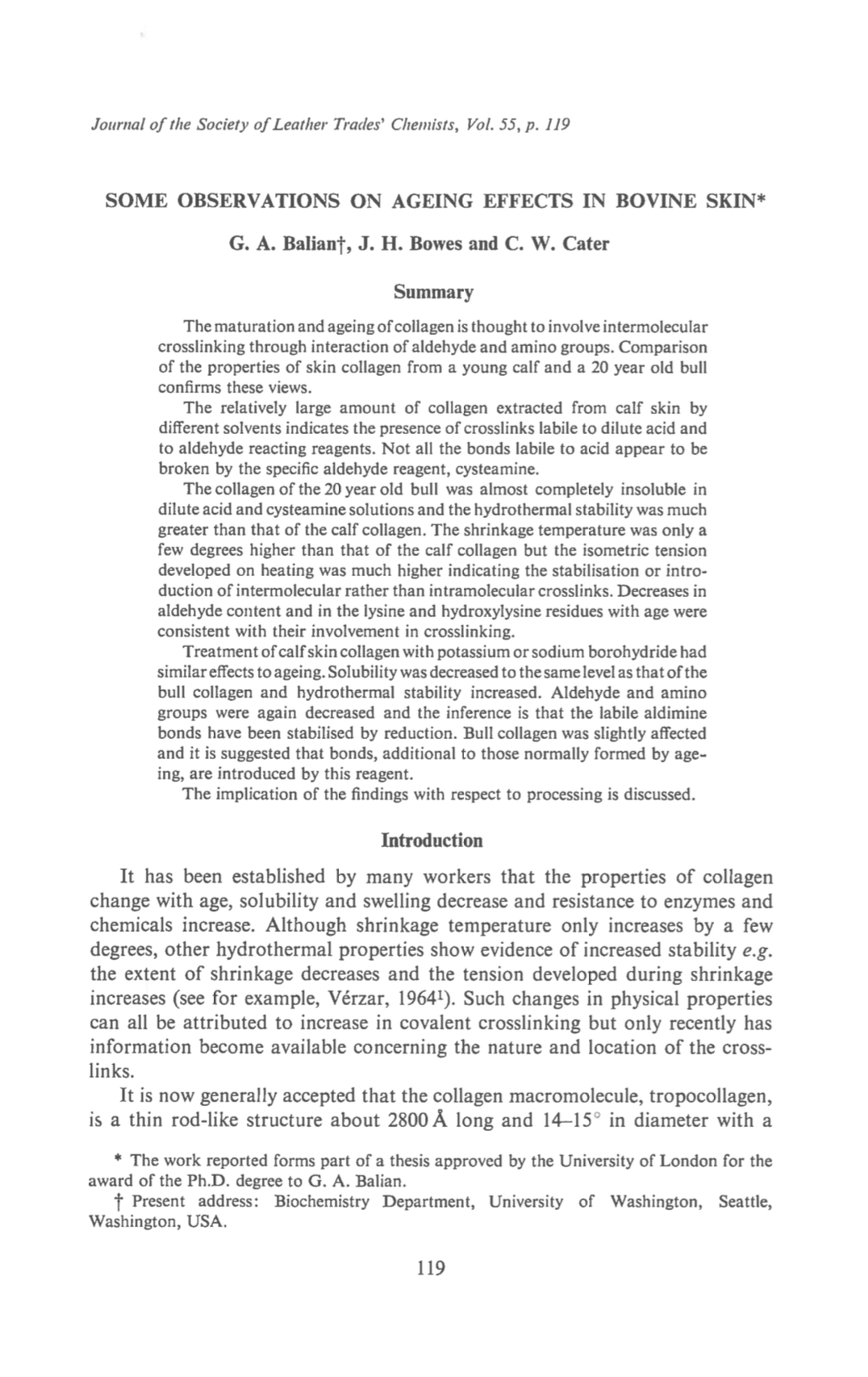
The maturation and ageing of collagen is thought to involve intermolecular crosslinking through interaction of aldehyde and amino groups. Comparison of the properties of skin collagen from a young calf and a 20 year old bull confirms these views. The relatively large amount of collagen extracted from calf skin by different solvents indicates the presence of crosslinks labile to dilute acid and to aldehyde reacting reagents. Not all the bonds labile to acid appear to be broken by the specific aldehyde reagent, cysteamine. The collagen of the 20 year old bull was almost completely insoluble in dilute acid and cysteamine solutions and the hydrothermal stability was much greater than that of the calf collagen. The shrinkage temperature was only a few degrees higher than that of the calf collagen but the isometric tension developed on heating was much higher indicating the stabilisation or introduction of intermolecular rather than intramolecular crosslinks. Decreases in aldehyde content and in the lysine and hydroxylysine residues with age were consistent with their involvement in crosslinking. Treatment of calf skin collagen with potassium or sodium borohydride had similar effects to ageing. Solubility was decreased to the same level as that of the bull collagen and hydrothermal stability increased. Aldehyde and amino groups were again decreased and the inference is that the labile aldimine bonds have been stabilised by reduction. Bull collagen was slightly affected and it is suggested that bonds, additional to those normally formed by ageing, are introduced by this reagent. The implication of the findings with respect to processing is discussed.
£20.00
Are you a member? Log in for access to the article.
Volume Number
55
Author(s)
G. A. BALIAN; J. H. BOWES; C. W. CATER
Some Observations on Ageing Effects in Bovine Skin