Effect of Carboxyl Group Content of Collagen on Chromium Absorption
Abstract
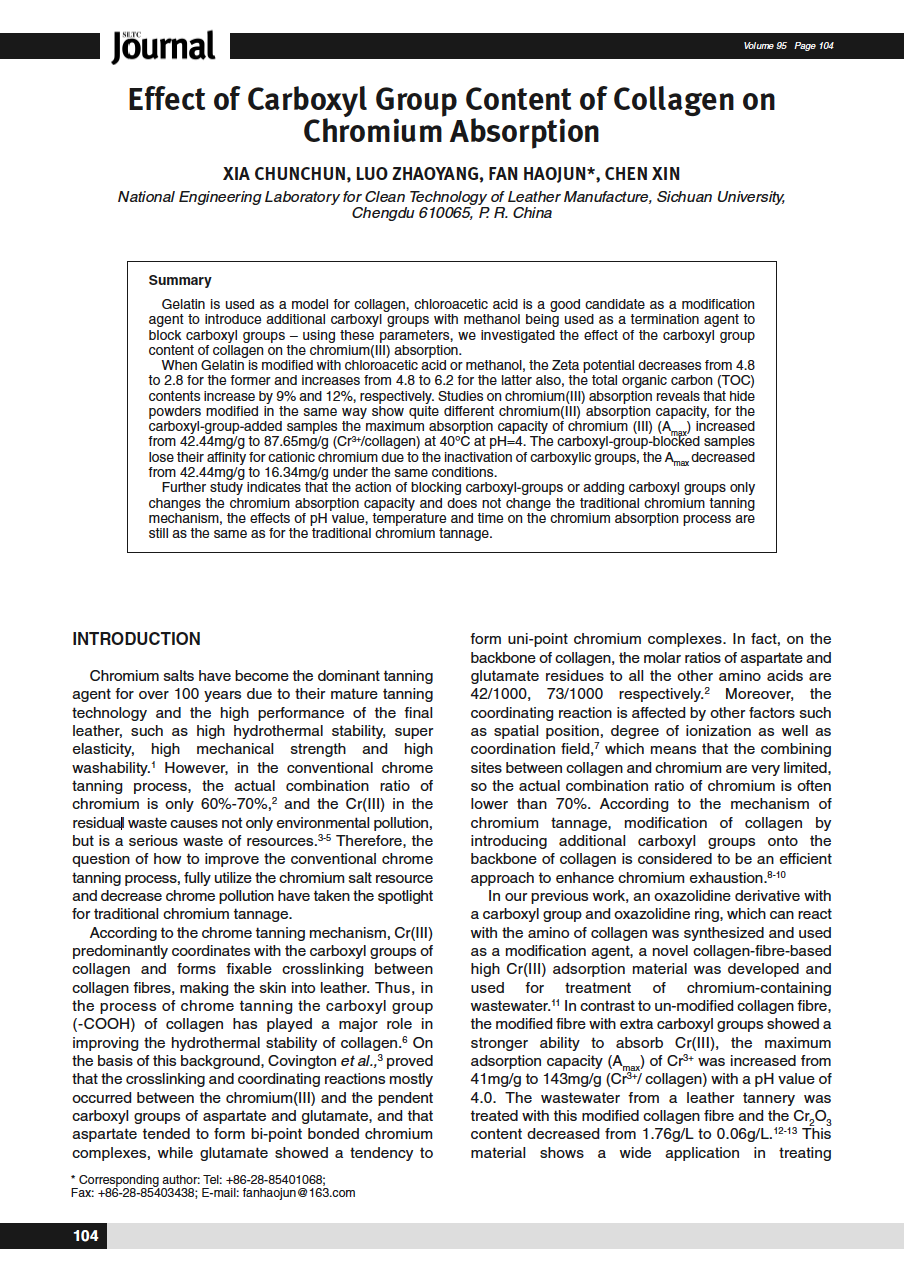
Gelatin is used as a model for collagen, chloroacetic acid is a good candidate as a modification agent to introduce additional carboxyl groups with methanol being used as a termination agent to block carboxyl groups – using these parameters, we investigated the effect of the carboxyl group content of collagen on the chromium(III) absorption.
When Gelatin is modified with chloroacetic acid or methanol, the Zeta potential decreases from 4.8 to 2.8 for the former and increases from 4.8 to 6.2 for the latter also, the total organic carbon (TOC) contents increase by 9% and 12%, respectively. Studies on chromium(III) absorption reveals that hide powders modified in the same way show quite different chromium(III) absorption capacity, for the carboxyl-group-added samples the maximum absorption capacity of chromium (III) (Amax) increased from 42.44mg/g to 87.65mg/g (Cr3+/collagen) at 40°C at pH=4. The carboxyl-group-blocked samples lose their affinity for cationic chromium due to the inactivation of carboxylic groups, the Amax decreased from 42.44mg/g to 16.34mg/g under the same conditions.
Further study indicates that the action of blocking carboxyl-groups or adding carboxyl groups only changes the chromium absorption capacity and does not change the traditional chromium tanning mechanism, the effects of pH value, temperature and time on the chromium absorption process are still as the same as for the traditional chromium tannage.
£20.00
Are you a member? Log in for access to the article.
Volume Number
95
Author(s)
XIA CHUNCHUN; LUO ZHAOYANG; FAN HAOJUN; CHEN XIN
Effect of Carboxyl Group Content of Collagen on Chromium Absorption