Antioxidant Effects Of Phenolic Compounds On Unsaturated Lipids Preventing The Oxidation Of Chrome(III)
Abstract
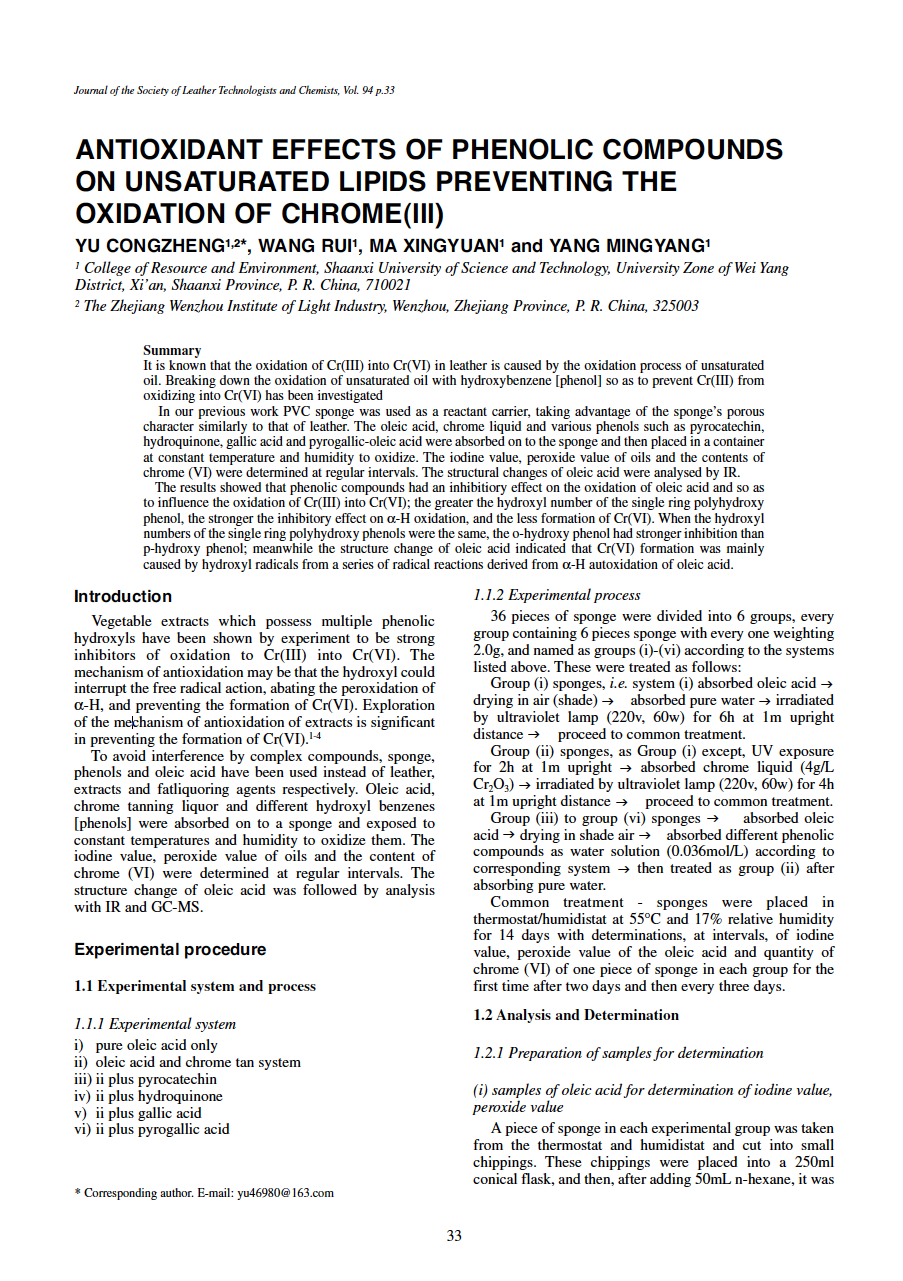
It is known that the oxidation of Cr(III) into Cr(VI) in leather is caused by the oxidation process of unsaturated oil. Breaking down the oxidation of unsaturated oil with hydroxybenzene [phenol] so as to prevent Cr(III) from oxidizing into Cr(VI) has been investigated.
In our previous work PVC sponge was used as a reactant carrier, taking advantage of the sponge’s porous character similarly to that of leather. The oleic acid, chrome liquid and various phenols such as pyrocatechin, hydroquinone, gallic acid and pyrogallic-oleic acid were absorbed on to the sponge and then placed in a container at constant temperature and humidity to oxidize. The iodine value, peroxide value of oils and the contents of chrome (VI) were determined at regular intervals. The structural changes of oleic acid were analysed by IR.
The results showed that phenolic compounds had an inhibitiory effect on the oxidation of oleic acid and so as to influence the oxidation of Cr(III) into Cr(VI); the greater the hydroxyl number of the single ring polyhydroxy phenol, the stronger the inhibitory effect on α-H oxidation, and the less formation of Cr(VI). When the hydroxyl numbers of the single ring polyhydroxy phenols were the same, the o-hydroxy phenol had stronger inhibition than p-hydroxy phenol; meanwhile the structure change of oleic acid indicated that Cr(VI) formation was mainly caused by hydroxyl radicals from a series of radical reactions derived from α-H autoxidation of oleic acid.
£20.00
Are you a member? Log in for access to the article.
Volume Number
94
Author(s)
YU CONGZHENG; WANG RUI; MA XINGYUAN; YANG MINGYANG
Antioxidant Effects Of Phenolic Compounds On Unsaturated Lipids Preventing The Oxidation Of Chrome(III)
Volume Number
94
Author(s)
YU CONGZHENG; WANG RUI; MA XINGYUAN; YANG MINGYANG