Leather Ageing and Hexavalent Chromium Formation as a Function of the Fatliquoring Agent. Part III: Interaction with Synthetic and Vegetable Retanning Agents
Abstract
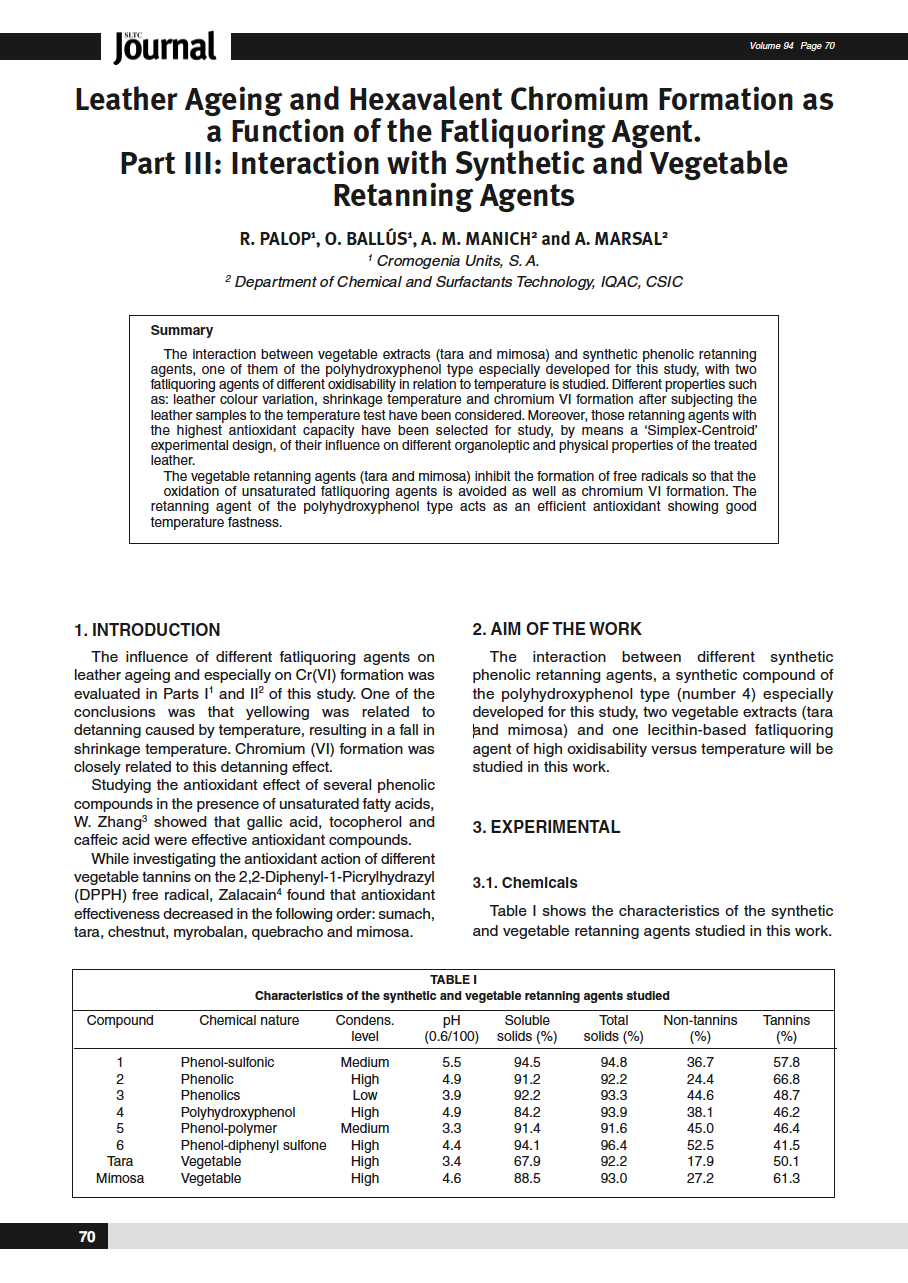
The interaction between vegetable extracts (tara and mimosa) and synthetic phenolic retanning agents, one of them of the polyhydroxyphenol type especially developed for this study, with two fatliquoring agents of different oxidisability in relation to temperature is studied.Different properties such as: leather colour variation, shrinkage temperature and chromium VI formation after subjecting the leather samples to the temperature test have been considered. Moreover, those retanning agents with the highest antioxidant capacity have been selected for study, by means a ‘Simplex-Centroid’ experimental design, of their influence on different organoleptic and physical properties of the treated leather.
The vegetable retanning agents (tara and mimosa) inhibit the formation of free radicals so that the oxidation of unsaturated fatliquoring agents is avoided as well as chromium VI formation. The retanning agent of the polyhydroxyphenol type acts as an efficient antioxidant showing good temperature fastness.
£20.00
Are you a member? Log in for access to the article.
Volume Number
94
Author(s)
R. PALOP; O. BALLÚS; A. M. MANICH; A. MARSAL
Leather Ageing and Hexavalent Chromium Formation as a Function of the Fatliquoring Agent. Part III: Interaction with Synthetic and Vegetable Retanning Agents