Mucoids in Skin and Their Significance to the Tanner
Abstract
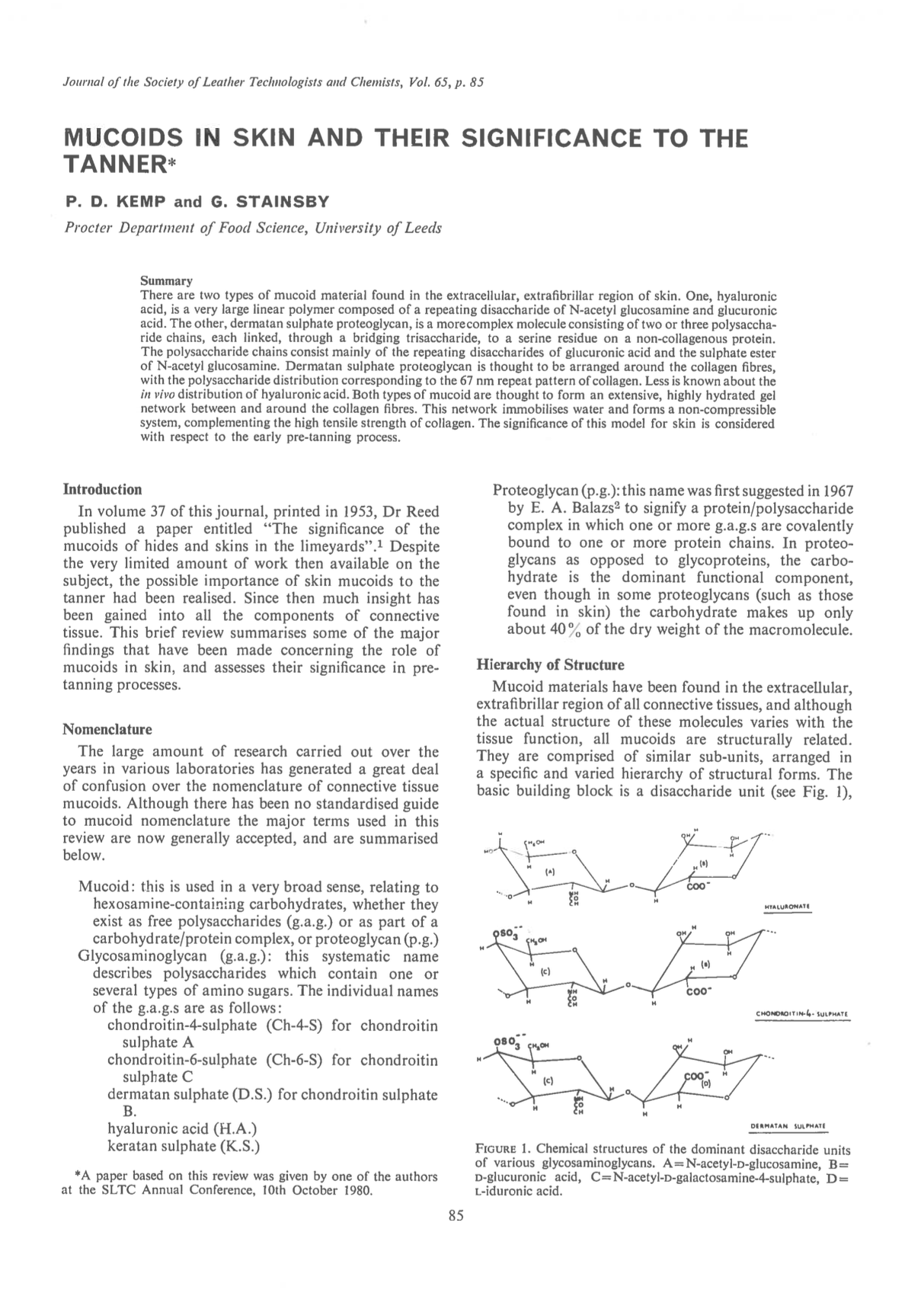
There are two types of mucoid material found in the extracellular, extrafibrillar region of skin. One, hyaluronic acid, is a very large linear polymer composed of a repeating disaccharide of N-acetyl glucosamine and glucuronic acid. The other, dermatan sulphate proteoglycan, is a morecomplex molecule consisting of two or three polysaccharide chains, each linked, through a bridging trisaccharide, to a serine residue on a non-collagenous protein. The polysaccharide chains consist mainly of the repeating disaccharides of glucuronic acid and the sulphate ester of N-acetyl glucosamine. Dermatan sulphate proteoglycan is thought to be arranged around the collagen fibres, with the polysaccharide distribution corresponding to the 67 nm repeat pattern of collagen. Less is known about the in vivo distribution of hyaluronic acid. Both types of mucoid are thought to form an extensive, highly hydrated gel network between and around the collagen fibres. This network immobilises water and forms a non-compressible system, complementing the high tensile strength of collagen. The significance of this model for skin is considered with respect to the early pre-tanning process.
£20.00
Are you a member? Log in for access to the article.
Volume Number
65
Author(s)
P. D. KEMP; G. STAINSBY
Mucoids in Skin and Their Significance to the Tanner