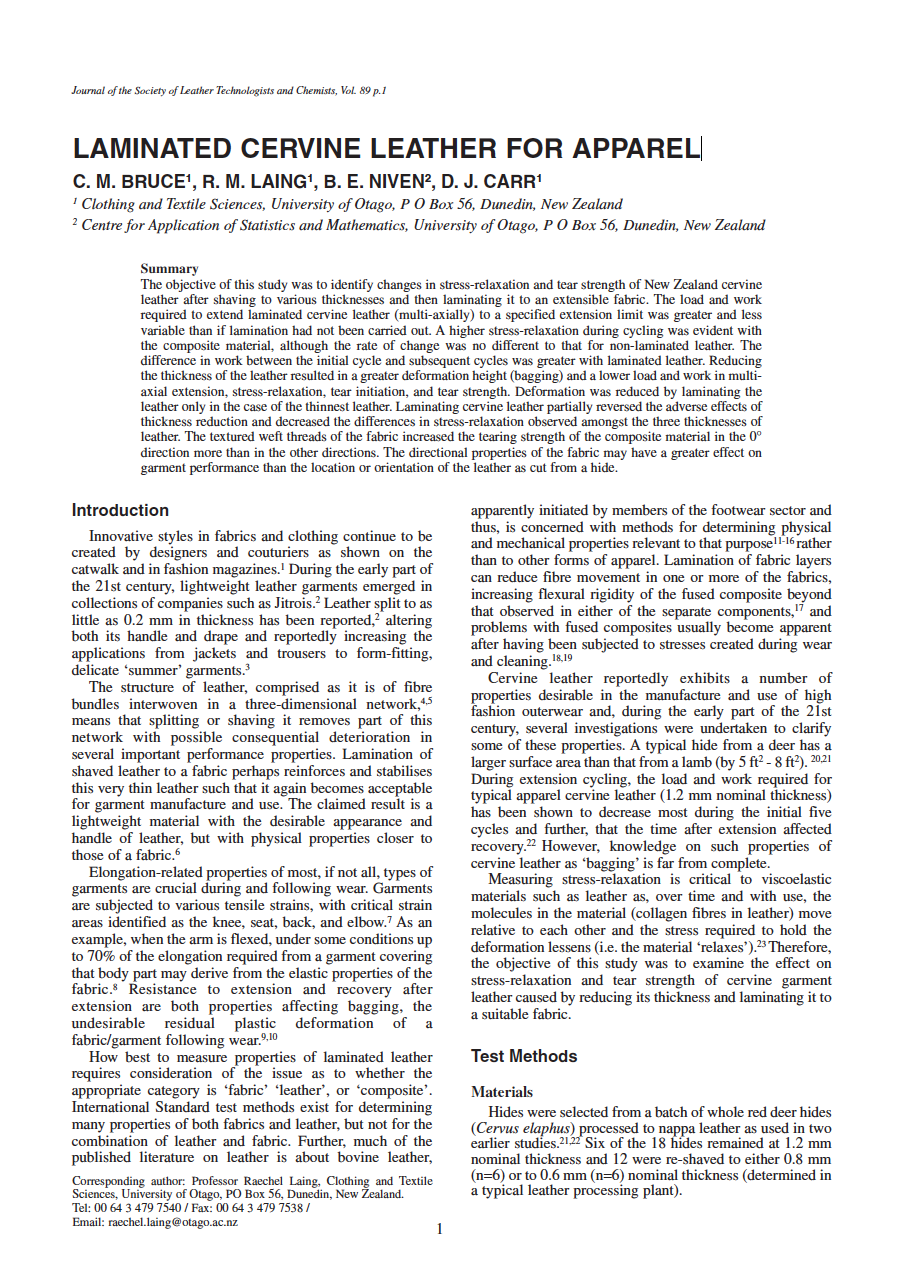
The objective of this study was to identify changes in stress-relaxation and tear strength of New Zealand cervine leather after shaving to various thicknesses and then laminating it to an extensible fabric. The load and work required to extend laminated cervine leather (multi-axially) to a specified extension limit was greater and less variable than if lamination had not been carried out. A higher stress-relaxation during cycling was evident with the composite material, although the rate of change was no different to that for non-laminated leather. The difference in work between the initial cycle and subsequent cycles was greater with laminated leather. Reducing the thickness of the leather resulted in a greater deformation height (bagging) and a lower load and work in multiaxial extension, stress-relaxation, tear initiation, and tear strength. Deformation was reduced by laminating the leather only in the case of the thinnest leather. Laminating cervine leather partially reversed the adverse effects of thickness reduction and decreased the differences in stress-relaxation observed amongst the three thicknesses of leather. The textured weft threads of the fabric increased the tearing strength of the composite material in the 0° direction more than in the other directions. The directional properties of the fabric may have a greater effect on garment performance than the location or orientation of the leather as cut from a hide.
£20.00
Are you a member? Log in for access to the article.