An Integrated Approach For The Treatment Of Vegetable Tanning Wastewaters
Abstract
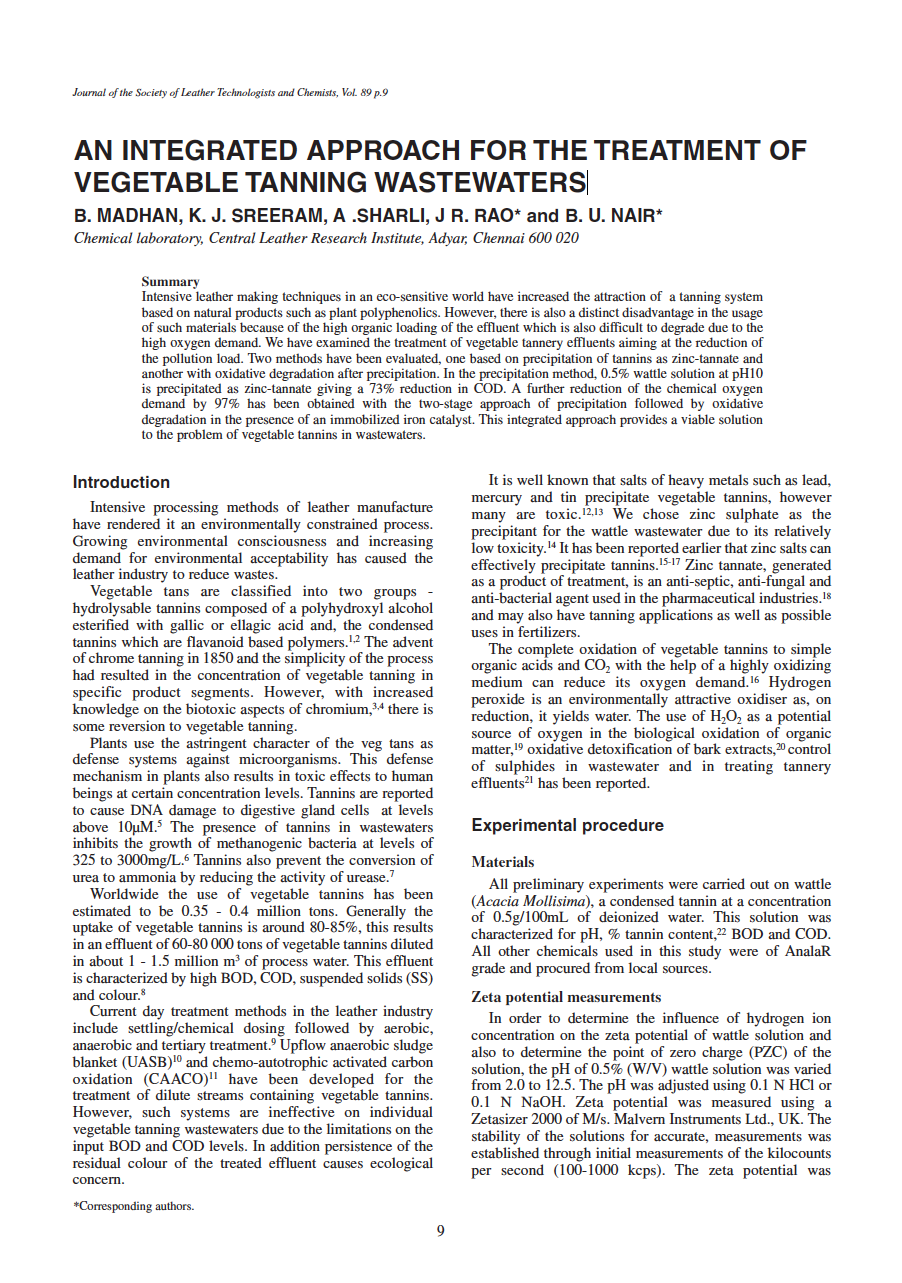
Intensive leather making techniques in an eco-sensitive world have increased the attraction of a tanning system based on natural products such as plant polyphenolics. However, there is also a distinct disadvantage in the usage of such materials because of the high organic loading of the effluent which is also difficult to degrade due to the high oxygen demand. We have examined the treatment of vegetable tannery effluents aiming at the reduction of the pollution load. Two methods have been evaluated, one based on precipitation of tannins as zinc-tannate and another with oxidative degradation after precipitation. In the precipitation method, 0.5% wattle solution at pH10 is precipitated as zinc-tannate giving a 73% reduction in COD. A further reduction of the chemical oxygen demand by 97% has been obtained with the two-stage approach of precipitation followed by oxidative degradation in the presence of an immobilized iron catalyst. This integrated approach provides a viable solution to the problem of vegetable tannins in wastewaters.
£20.00
Are you a member? Log in for access to the article.
Volume Number
89
Author(s)
B. MADHAN; K. J. SREERAM; A .SHARLI; J R. RAO; B. U. NAIR
An Integrated Approach For The Treatment Of Vegetable Tanning Wastewaters
Volume Number
89
Author(s)
B. MADHAN; K. J. SREERAM; A .SHARLI; J R. RAO; B. U. NAIR