Anaerobic Digestion Of Animal Glue Industry Solid Wastes
Abstract
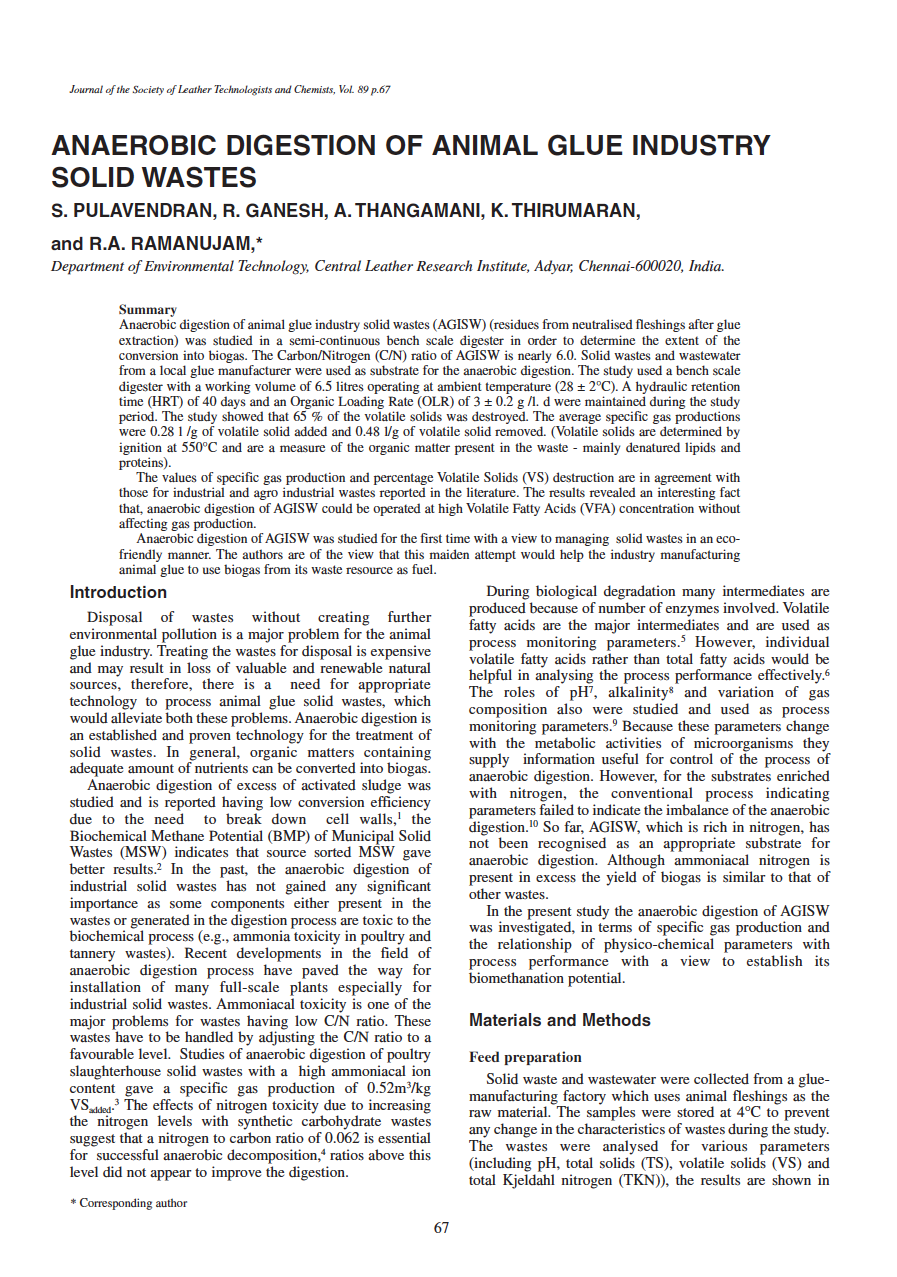
Anaerobic digestion of animal glue industry solid wastes (AGISW) (residues from neutralised fleshings after glue extraction) was studied in a semi-continuous bench scale digester in order to determine the extent of the conversion into biogas. The Carbon/Nitrogen (C/N) ratio of AGISW is nearly 6.0. Solid wastes and wastewater from a local glue manufacturer were used as substrate for the anaerobic digestion. The study used a bench scale digester with a working volume of 6.5 litres operating at ambient temperature (28 ± 2°C). A hydraulic retention time (HRT) of 40 days and an Organic Loading Rate (OLR) of 3 ± 0.2 g /l. d were maintained during the study period. The study showed that 65 % of the volatile solids was destroyed. The average specific gas productions were 0.28 l /g of volatile solid added and 0.48 l/g of volatile solid removed. (Volatile solids are determined by ignition at 550°C and are a measure of the organic matter present in the waste – mainly denatured lipids and proteins).
The values of specific gas production and percentage Volatile Solids (VS) destruction are in agreement with those for industrial and agro industrial wastes reported in the literature. The results revealed an interesting fact that, anaerobic digestion of AGISW could be operated at high Volatile Fatty Acids (VFA) concentration without affecting gas production.
Anaerobic digestion of AGISW was studied for the first time with a view to managing solid wastes in an ecofriendly manner. The authors are of the view that this maiden attempt would help the industry manufacturing animal glue to use biogas from its waste resource as fuel.
£20.00
Are you a member? Log in for access to the article.
Volume Number
89
Author(s)
S. PULAVENDRAN; R. GANESH; A. THANGAMANI; K. THIRUMARAN; R.A. RAMANUJAM
Anaerobic Digestion Of Animal Glue Industry Solid Wastes
Volume Number
89
Author(s)
S. PULAVENDRAN; R. GANESH; A. THANGAMANI; K. THIRUMARAN; R.A. RAMANUJAM