
SLTC 2027 CONFERENCE 16-17th APRIL – SAVE THE DATE
Abstract
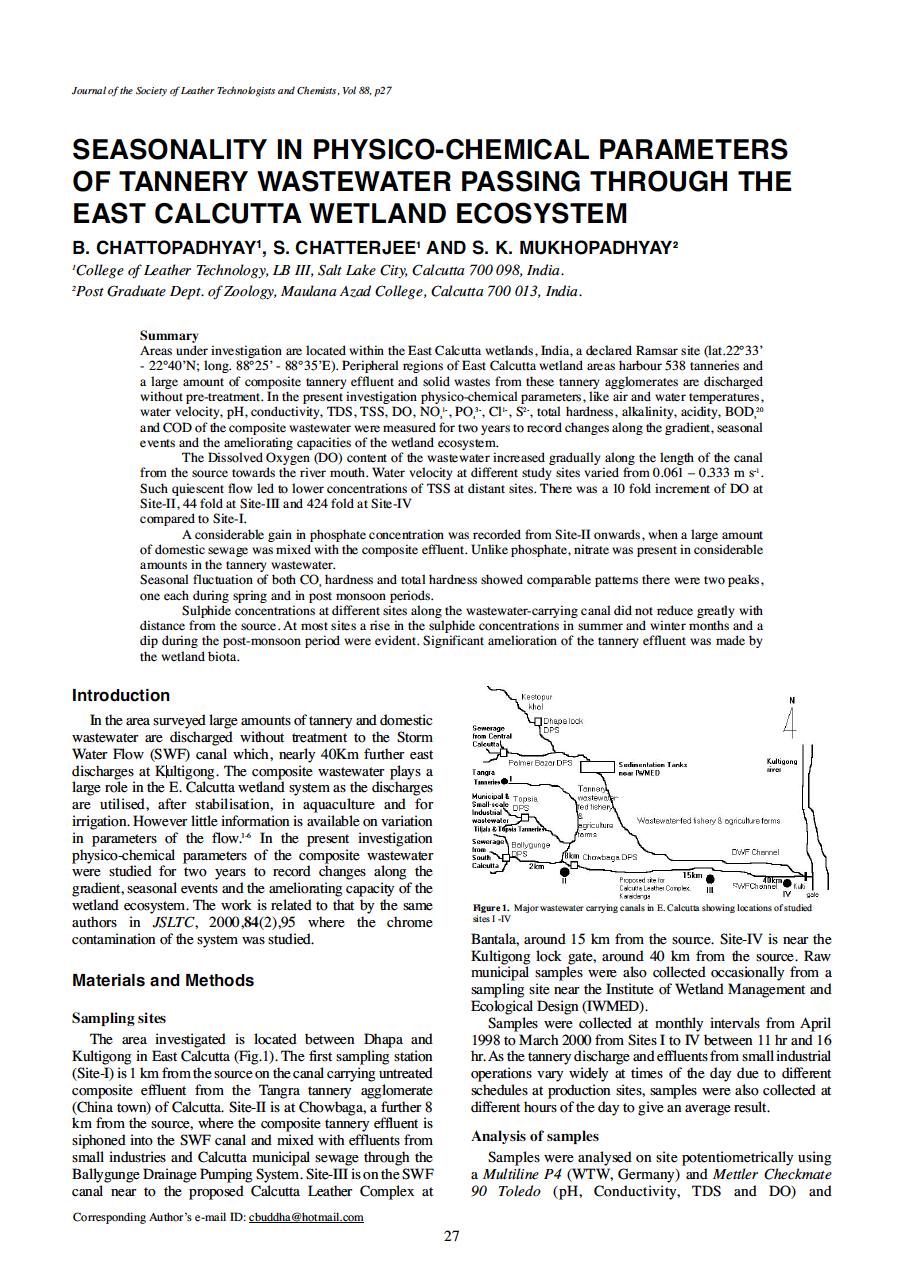
Areas under investigation are located within the East Calcutta wetlands, India, a declared Ramsar site (lat.22°33’ – 22°40’N; long. 88°25’ – 88°35’E). Peripheral regions of East Calcutta wetland areas harbour 538 tanneries and a large amount of composite tannery effluent and solid wastes from these tannery agglomerates are discharged without pre-treatment. In the present investigation physico-chemical parameters, like air and water temperatures, water velocity, pH, conductivity, TDS, TSS, DO, NO3 1-, PO4 3-, Cl1-, S2-, total hardness, alkalinity, acidity, BOD5 20 and COD of the composite wastewater were measured for two years to record changes along the gradient, seasonal events and the ameliorating capacities of the wetland ecosystem.
The Dissolved Oxygen (DO) content of the wastewater increased gradually along the length of the canal from the source towards the river mouth. Water velocity at different study sites varied from 0.061 – 0.333 m s-1. Such quiescent flow led to lower concentrations of TSS at distant sites. There was a 10 fold increment of DO at Site-II, 44 fold at Site-III and 424 fold at Site-IV compared to Site-I.
A considerable gain in phosphate concentration was recorded from Site-II onwards, when a large amount of domestic sewage was mixed with the composite effluent. Unlike phosphate, nitrate was present in considerable amounts in the tannery wastewater. Seasonal fluctuation of both CO3 hardness and total hardness showed comparable patterns there were two peaks, one each during spring and in post monsoon periods.
Sulphide concentrations at different sites along the wastewater-carrying canal did not reduce greatly with distance from the source. At most sites a rise in the sulphide concentrations in summer and winter months and a dip during the post-monsoon period were evident. Significant amelioration of the tannery effluent was made by the wetland biota.
£20.00
Are you a member? Log in for access to the article.