Adsorption Of Dyes From Aqueous Solution By Chromium-Containing Leather Waste
Abstract
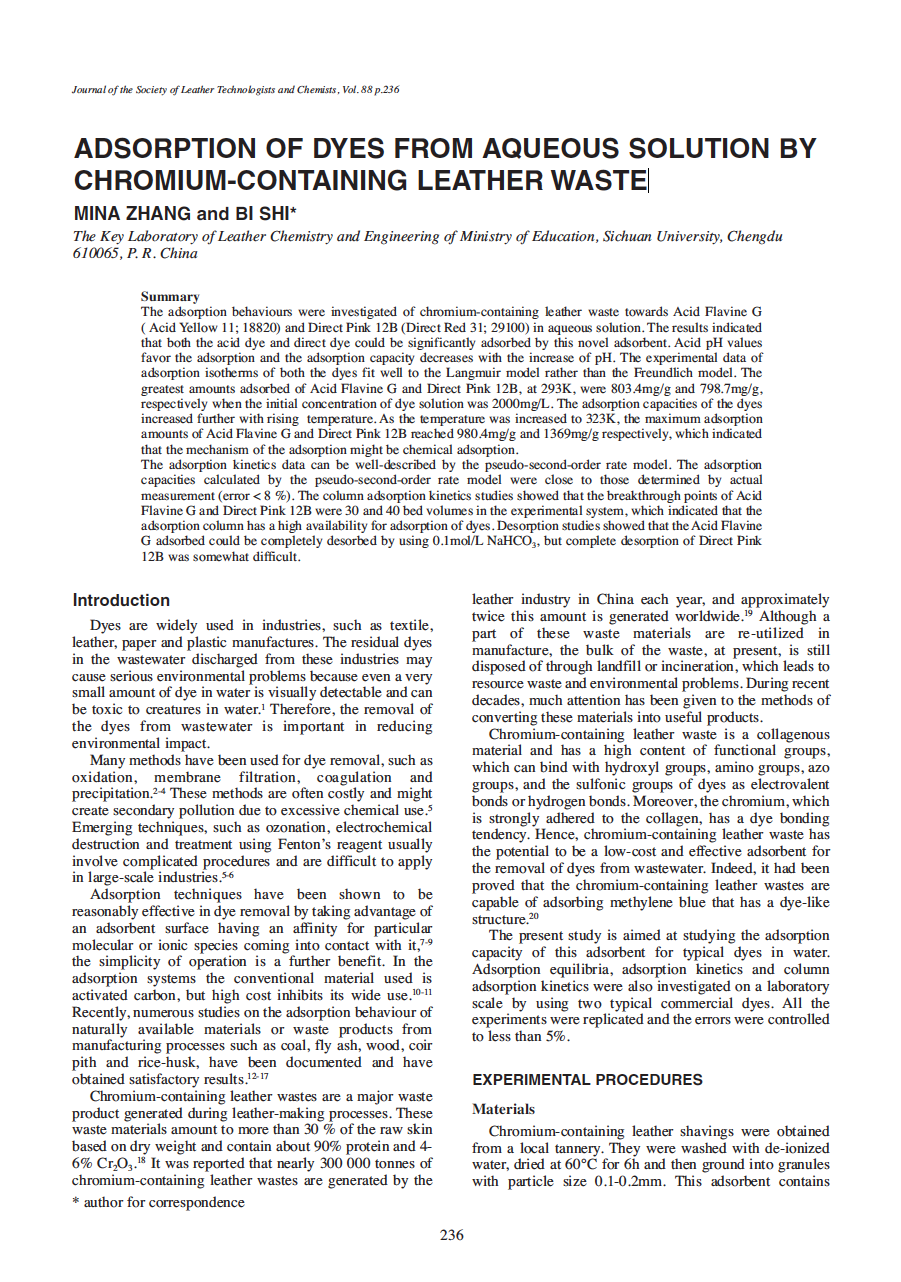
The adsorption behaviours were investigated of chromium-containing leather waste towards Acid Flavine G ( Acid Yellow 11; 18820) and Direct Pink 12B (Direct Red 31; 29100) in aqueous solution. The results indicated that both the acid dye and direct dye could be significantly adsorbed by this novel adsorbent. Acid pH values favor the adsorption and the adsorption capacity decreases with the increase of pH. The experimental data of adsorption isotherms of both the dyes fit well to the Langmuir model rather than the Freundlich model. The greatest amounts adsorbed of Acid Flavine G and Direct Pink 12B, at 293K, were 803.4mg/g and 798.7mg/g, respectively when the initial concentration of dye solution was 2000mg/L. The adsorption capacities of the dyes increased further with rising temperature. As the temperature was increased to 323K, the maximum adsorption amounts of Acid Flavine G and Direct Pink 12B reached 980.4mg/g and 1369mg/g respectively, which indicated that the mechanism of the adsorption might be chemical adsorption. The adsorption kinetics data can be well-described by the pseudo-second-order rate model. The adsorption capacities calculated by the pseudo-second-order rate model were close to those determined by actual measurement (error < 8 %). The column adsorption kinetics studies showed that the breakthrough points of Acid Flavine G and Direct Pink 12B were 30 and 40 bed volumes in the experimental system, which indicated that the adsorption column has a high availability for adsorption of dyes. Desorption studies showed that the Acid Flavine G adsorbed could be completely desorbed by using 0.1mol/L NaHCO3, but complete desorption of Direct Pink 12B was somewhat difficult.
£20.00
Are you a member? Log in for access to the article.
Volume Number
88
Author(s)
MINA ZHANG; BI SHI
Adsorption Of Dyes From Aqueous Solution By Chromium-Containing Leather Waste