Evaluation Of Environmental Impact Of Typical Leather Chemicals. Part III: Biodegradability Of Vegetable Tannin Extracts By Activated Sludge
Abstract
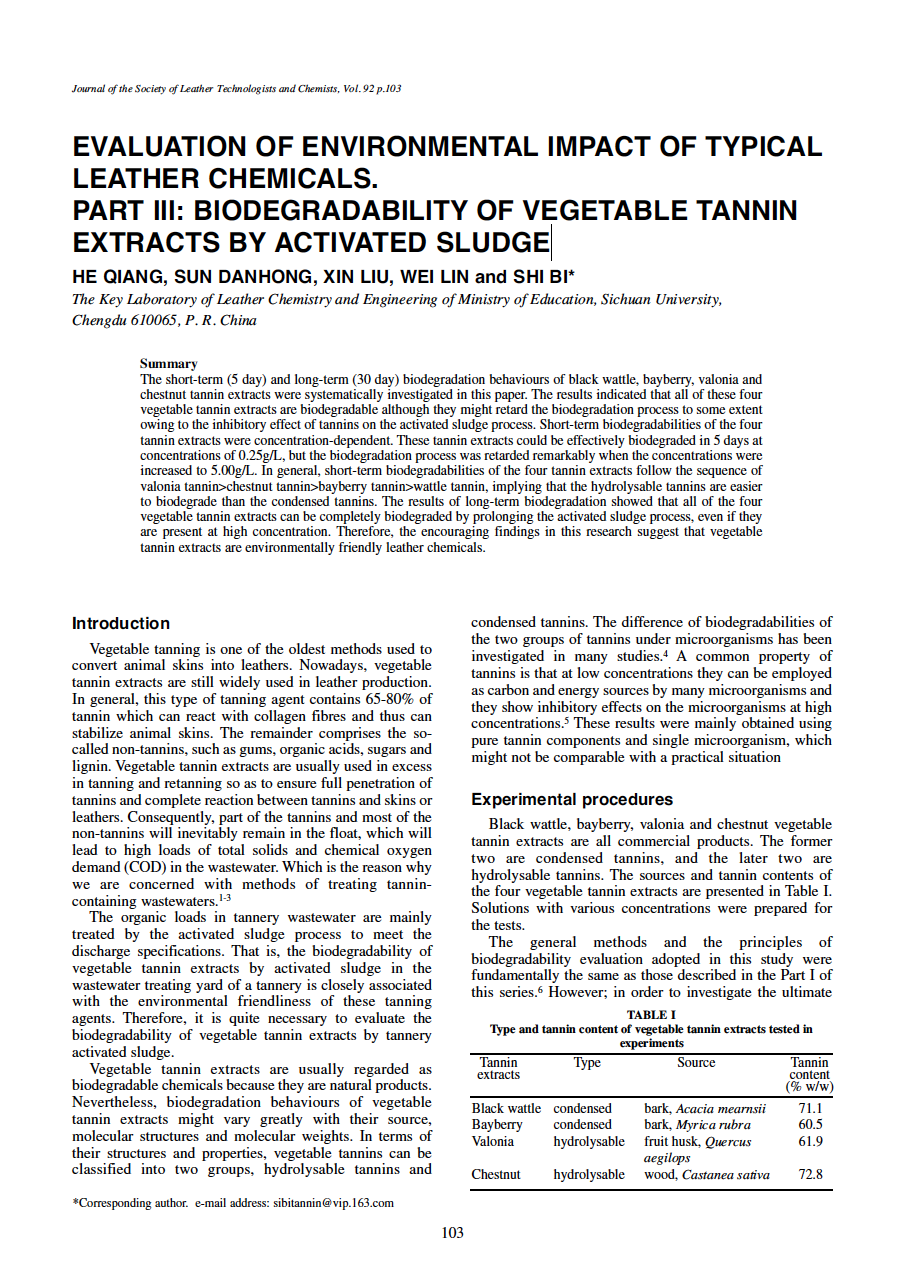
The short-term (5 day) and long-term (30 day) biodegradation behaviours of black wattle, bayberry, valonia and chestnut tannin extracts were systematically investigated in this paper. The results indicated that all of these four vegetable tannin extracts are biodegradable although they might retard the biodegradation process to some extent owing to the inhibitory effect of tannins on the activated sludge process. Short-term biodegradabilities of the four tannin extracts were concentration-dependent. These tannin extracts could be effectively biodegraded in 5 days at concentrations of 0.25g/L, but the biodegradation process was retarded remarkably when the concentrations were increased to 5.00g/L. In general, short-term biodegradabilities of the four tannin extracts follow the sequence of valonia tannin>chestnut tannin>bayberry tannin>wattle tannin, implying that the hydrolysable tannins are easier to biodegrade than the condensed tannins. The results of long-term biodegradation showed that all of the four vegetable tannin extracts can be completely biodegraded by prolonging the activated sludge process, even if they are present at high concentration. Therefore, the encouraging findings in this research suggest that vegetable tannin extracts are environmentally friendly leather chemicals.
£20.00
Are you a member? Log in for access to the article.
Volume Number
92
Author(s)
HE QIANG; SUN DANHONG; XIN LIU; WEI LIN; SHI BI
Evaluation Of Environmental Impact Of Typical Leather Chemicals. Part III: Biodegradability Of Vegetable Tannin Extracts By Activated Sludge