An Integrated Eco-Friendly Tanning Method For The Manufacture Of Upper Leathers From Goatskins
Abstract
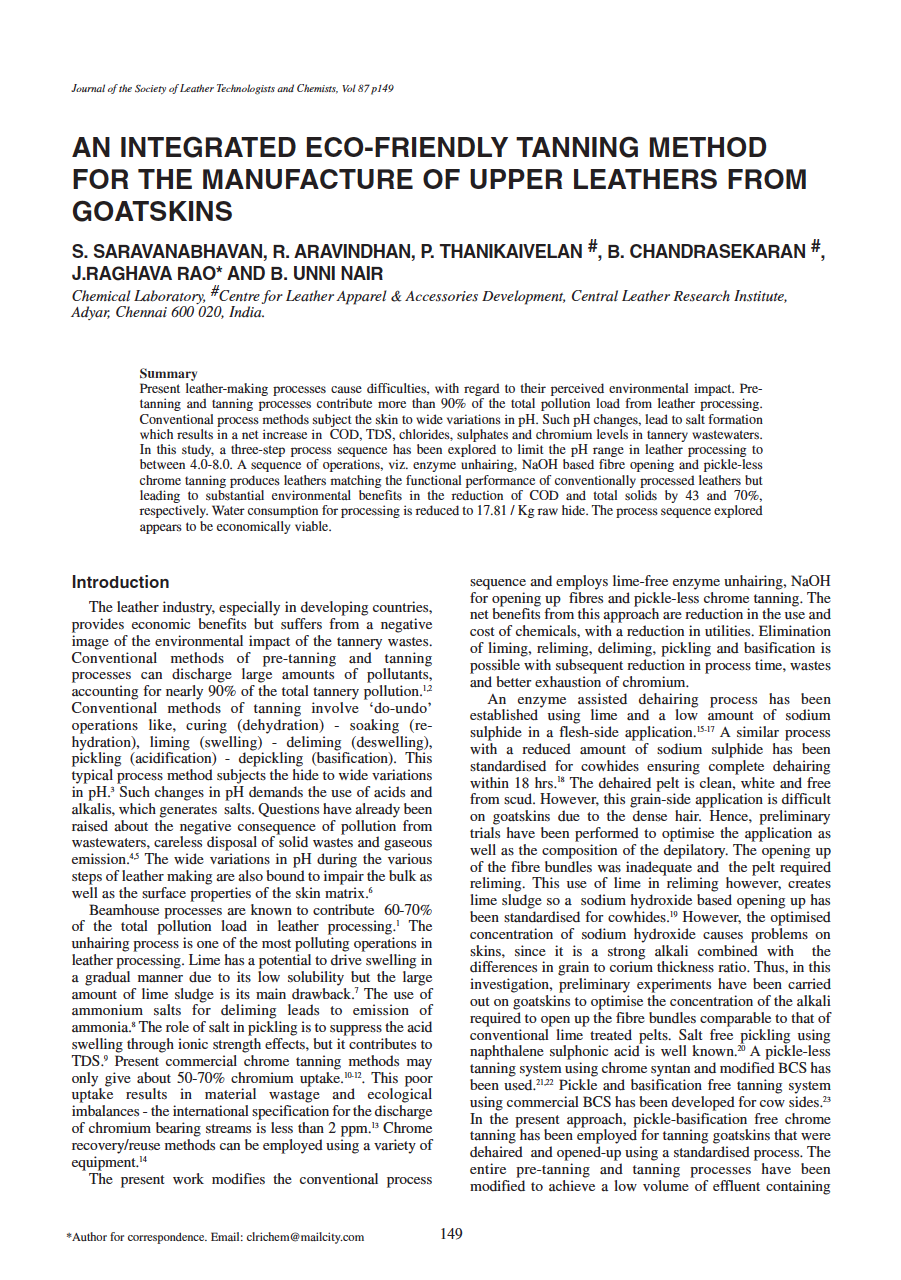
Present leather-making processes cause difficulties, with regard to their perceived environmental impact. Pretanning and tanning processes contribute more than 90% of the total pollution load from leather processing. Conventional process methods subject the skin to wide variations in pH. Such pH changes, lead to salt formation which results in a net increase in COD, TDS, chlorides, sulphates and chromium levels in tannery wastewaters. In this study, a three-step process sequence has been explored to limit the pH range in leather processing to between 4.0-8.0. A sequence of operations, viz. enzyme unhairing, NaOH based fibre opening and pickle-less chrome tanning produces leathers matching the functional performance of conventionally processed leathers but leading to substantial environmental benefits in the reduction of COD and total solids by 43 and 70%, respectively. Water consumption for processing is reduced to 17.81 / Kg raw hide. The process sequence explored appears to be economically viable.
£20.00
Are you a member? Log in for access to the article.
Volume Number
87
Author(s)
Z. BAJZA; P. HITREC; M. MUZIC
An Integrated Eco-Friendly Tanning Method For The Manufacture Of Upper Leathers From Goatskins