Bibliometric Analysis Reveals the Research Status and Trends of Chromium-Free Tanning Agents
Abstract
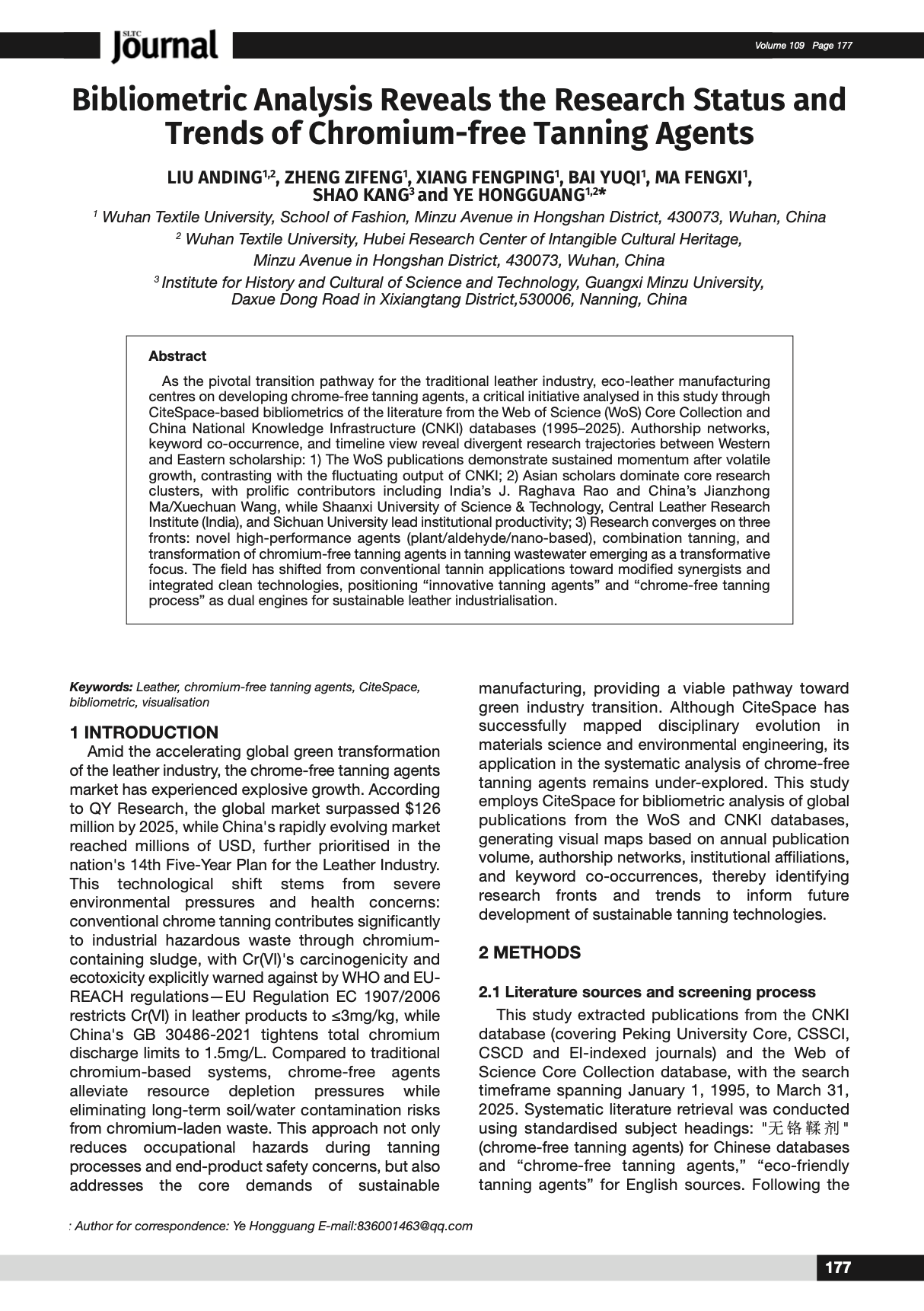
As the pivotal transition pathway for the traditional leather industry, eco-leather manufacturing centres on developing chrome-free tanning agents, a critical initiative analysed in this study through CiteSpace-based bibliometrics of the literature from the Web of Science (WoS) Core Collection and China National Knowledge Infrastructure (CNKI) databases (1995–2025). Authorship networks, keyword co-occurrence, and timeline view reveal divergent research trajectories between Western and Eastern scholarship: 1) The WoS publications demonstrate sustained momentum after volatile growth, contrasting with the fluctuating output of CNKI; 2) Asian scholars dominate core research clusters, with prolific contributors including India’s J. Raghava Rao and China’s Jianzhong Ma/Xuechuan Wang, while Shaanxi University of Science & Technology, Central Leather Research Institute (India), and Sichuan University lead institutional productivity; 3) Research converges on three fronts: novel high-performance agents (plant/aldehyde/nano-based), combination tanning, and transformation of chromium-free tanning agents in tanning wastewater emerging as a transformative focus. The field has shifted from conventional tannin applications toward modified synergists and integrated clean technologies, positioning “innovative tanning agents” and “chrome-free tanning process” as dual engines for sustainable leather industrialisation.
£20.00
Are you a member? Log in for access to the article.
Volume Number
109
Author(s)
LIU ANDING; ZHENG ZIFENG; XIANG FENGPING; BAI YUQI; MA FENGXI; SHAO KANG; YE HONGGUANG
Bibliometric Analysis Reveals the Research Status and Trends of Chromium-Free Tanning Agents
Volume Number
109
Author(s)
LIU ANDING; ZHENG ZIFENG; XIANG FENGPING; BAI YUQI; MA FENGXI; SHAO KANG; YE HONGGUANG