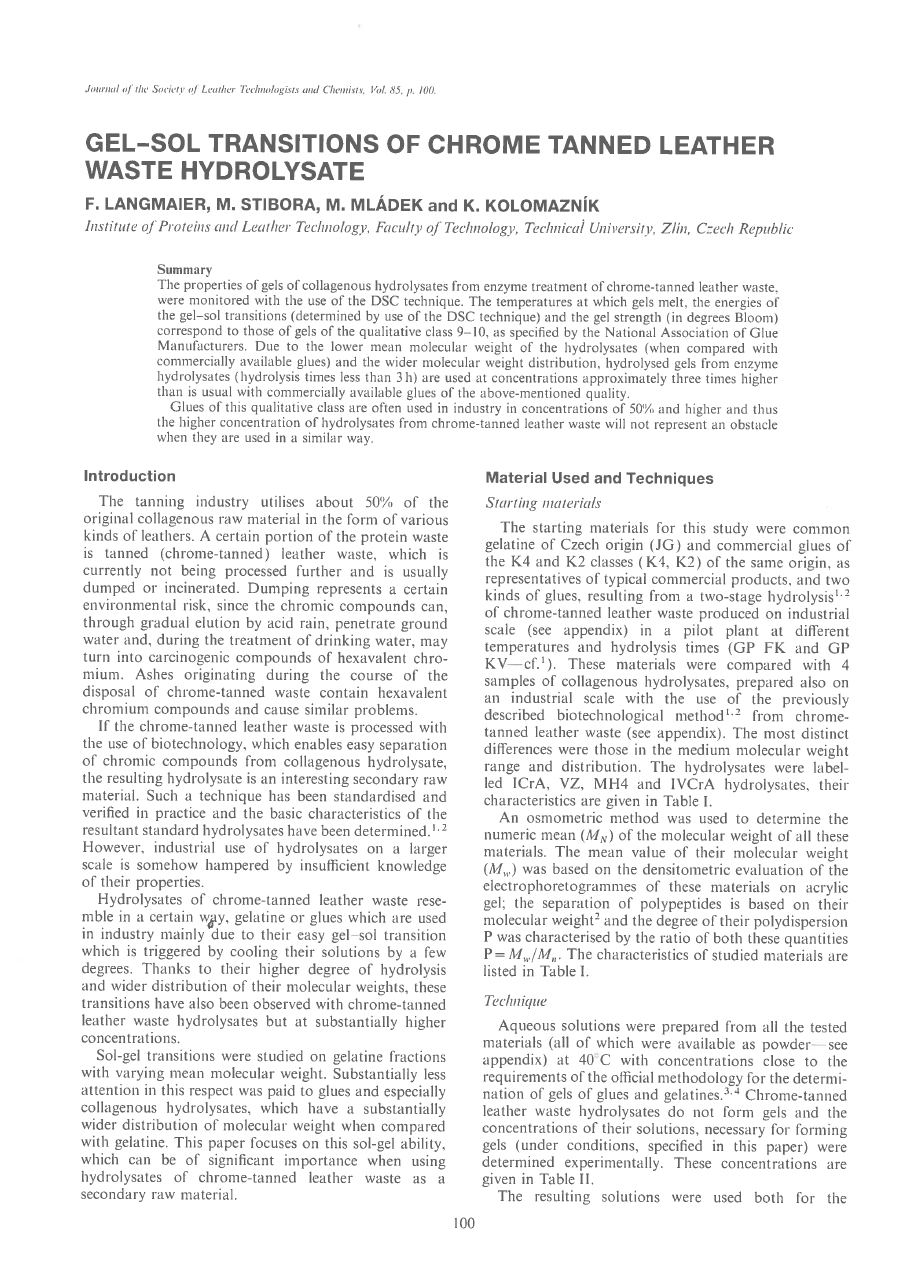
Gel-Sol Transitions Of Chrome Tanned Leather Waste Hydrolysate
Abstract
The properties of gels of collagenous hydro]ysates from enzyme treatment of chrome-tanned leather waste, were monitored with the use of the DSC technique. The temperatures at which gels melt, the energies of the gel—sol transitions (determined by use of the DSC technique) and the gel strength (in degrees Bloom) correspond to those of gels of the qualitative class 9—10, as specified by the National Association of Glue Manufacturers. Due to the lower mean molecular weight of the hydrolysates (when compared with commercially available glues) and the wider molecular weight distribution. hydrolysed gels from enzyme hydrolysates (hydrolysis times less than 3 h) are used at concentrations approximately three times higher than is usual with commercially available glues of the above—mentioned quality.
Glues of this qualitative class are often used in industry in concentrations of 50/ and higher and thus the higher concentration of hydrolysates from chrome-tanned leather waste will not represent an obstacle when they are used in a similar way.
£20.00
Are you a member? Log in for access to the article.
Volume Number
85
Author(s)
F. LANGMAIER; M. STIBORA; M. MLADEK; K. KOLOMAZNK
Gel-Sol Transitions Of Chrome Tanned Leather Waste Hydrolysate