Development Of Leather Processing Method In Narrow pH Profile: Part 2. Standardisation Of Tanning Process
Abstract
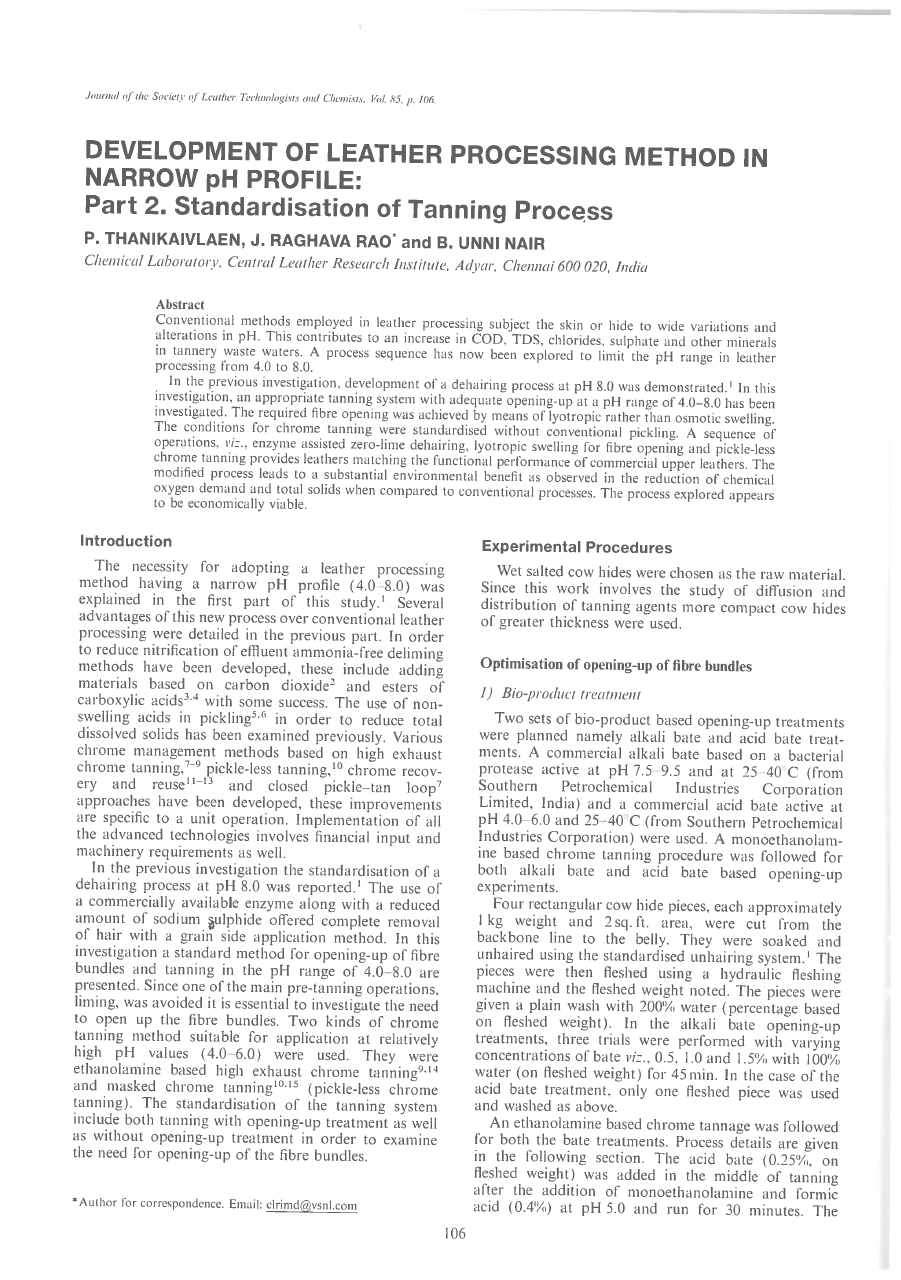
Conventional methods employed in leather processing subject the skin or hide to wide variations and alterations in pH. This contributes to an increase in COD. TDS. chlorides, sulphate and other minerals in tannery waste waters. A process sequence has now been explored to limit the pH range in leather processing from 4.0 to 8.0. In the previous investigation, development of a dehairing process at pH 8.0 was demonstrated.’
In this investigation, an appropriate tanning system with adequate opening—up at a pH range of 4.0—8.0 has been investigated. The required fibre opening was achieved by means of lyotropic rather than osmotic swelling. The conditions for chrome tanning were standardised without conventional pickling. A sequence of operations, viz., enzyme assisted zero-lime dehairing, lyotropic swelling for fibre opening and pickle-less chrome tanning provides leathers matching the functional performance of commercial upper leathers. The modified process leads to a substantial environmental benefit as observed in the reduction of chemical oxygen demand and total solids when compared to conventional processes. The process explored appears to be economically viable.
£20.00
Are you a member? Log in for access to the article.
Volume Number
85
Author(s)
P. THANIKAIVLAEN; J. RAGHAVA RAO; B. UNNI NAIR
Development Of Leather Processing Method In Narrow pH Profile: Part 2. Standardisation Of Tanning Process