Cr(VI) Formation In Leather During Post-Tanning Processes
Abstract
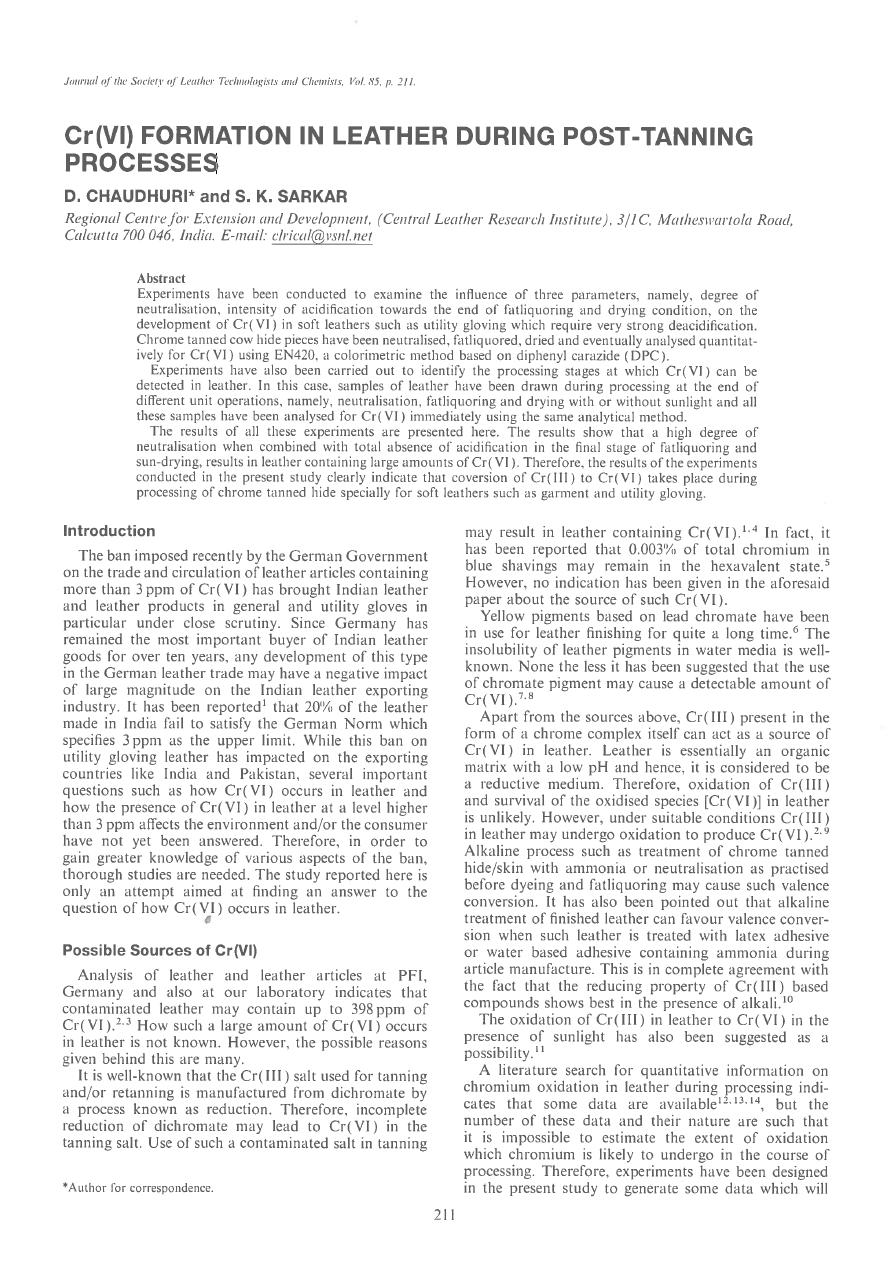
Experiments have been conducted to examine the influence of three parameters, namely, degree of neutralisation. intensity of acidification towards the end of fatliquoring and drying condition, on the development of Cr( VI) in soft leathers such as utility gloving which require very strong deacidification. Chrome tanned cow hide pieces have been neutralised, fatliquored, dried and eventually analysed quantitat ively for Cr(VI ) using EN420, a colorimetric method based on diphenyl carazide (DPC).
Experiments have also been carried out to identify the processing stages at which Cr( VI) can be detected in leather. In this case, samples of leather have been drawn during processing at the end of different unit operations, namely, neutralisation, fatliquoring and drying with or without sunlight and all these samples have been analysed for Cr(VI ) immediately using the same analytical method.
The results of all these experiments are presented here. The results show that a high degree of neutralisation when combined with total absence of acidification in the final stage of f’atliquoring and sun—drying, results in leather containing large amounts of Cr( VI). Therefore, the results of the experiments conducted in the present study clearly indicate that coversion of Cr( Ill) to Cr( VI) takes place during processing of chrome tanned hide specially for soft leathers such as garment and utility gloving.
£20.00
Are you a member? Log in for access to the article.
Volume Number
85
Author(s)
D. CHAUDHURI; S. K. SARKAR
Cr(VI) Formation In Leather During Post-Tanning Processes