Collagen Hydrolysate: ‘Soluble Skin’ Applied In Post-Tanning Processes Part 1: Characterisation
Abstract
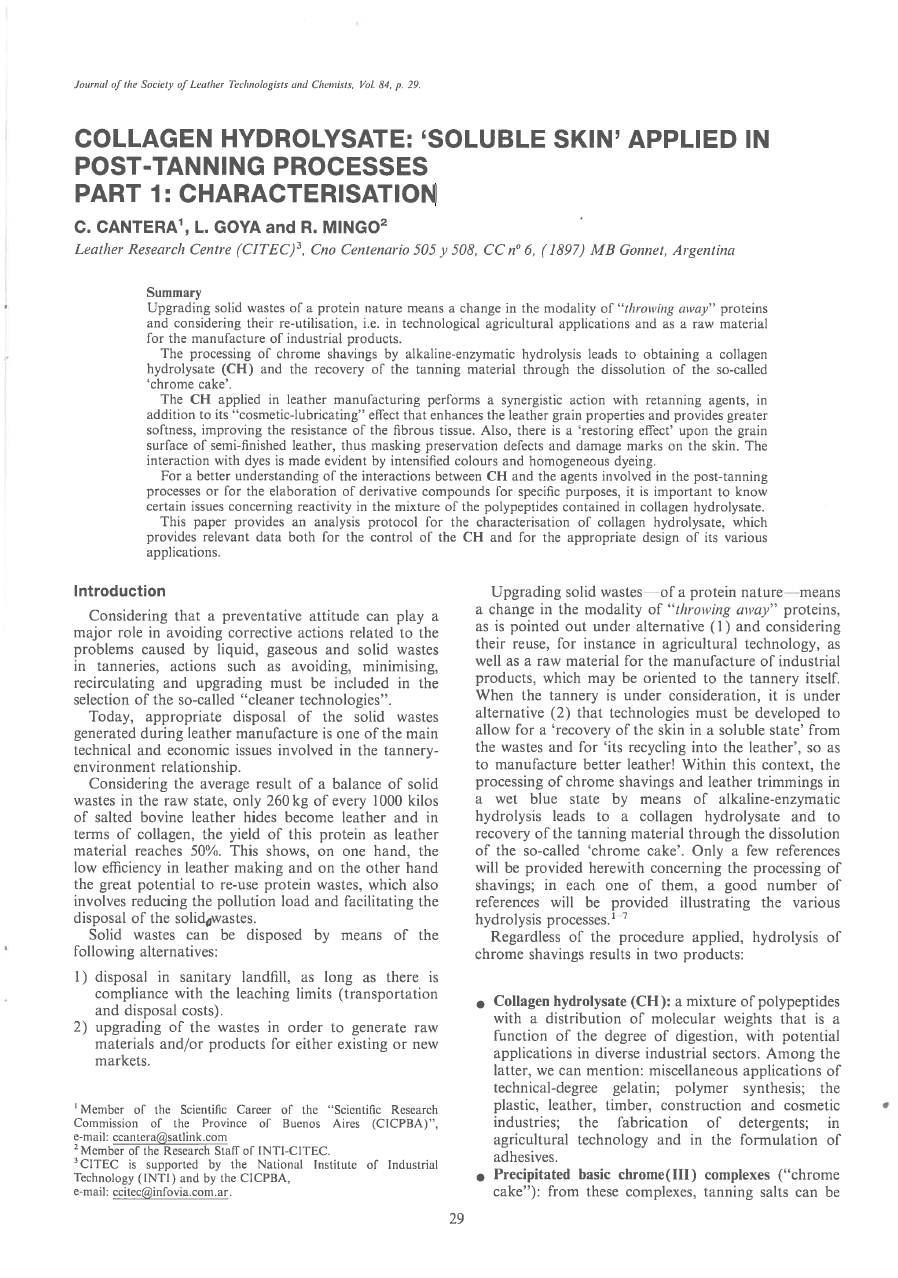
Upgrading solid wastes of a protein nature means a change in the modality of “throning aivav” proteins and considering their re-utilisation, i.e. in technological agricultural applications and as a raw material for the manufacture of industrial products.
The processing of chrome shavings by alkaline-enzymatic hydrolysis leads to obtaining a collagen hydrolysate (CH) and the recovery of the tanning material through the dissolution of the so-called ‘chrome cake’.
The CH applied in leather manufacturing performs a synergistic action with retanning agents, in addition to its “cosmetic-lubricating” effect that enhances the leather grain properties and provides greater softness, improving the resistance of the fibrous tissue. Also, there is a ‘restoring effect’ upon the grain surface of semi-finished leather, thus masking preservation defects and damage marks on the skin. The interaction with dyes is made evident by intensified colours and homogeneous dyeing.
For a better understanding of the interactions between CH and the agents involved in the post-tanning processes or for the elaboration of derivative compounds for specific purposes, it is important to know certain issues concerning reactivity in the mixture of the polypeptides contained in collagen hydrolysate.
This paper provides an analysis protocol for the characterisation of collagen hydrolysate, which provides relevant data both for the control of the CFI and for the appropriate design of its various applications.
£20.00
Are you a member? Log in for access to the article.
Volume Number
84
Author(s)
C. CANTERA; L. GOYA; R. MINGO
Collagen Hydrolysate: ‘Soluble Skin’ Applied In Post-Tanning Processes Part 1: Characterisation