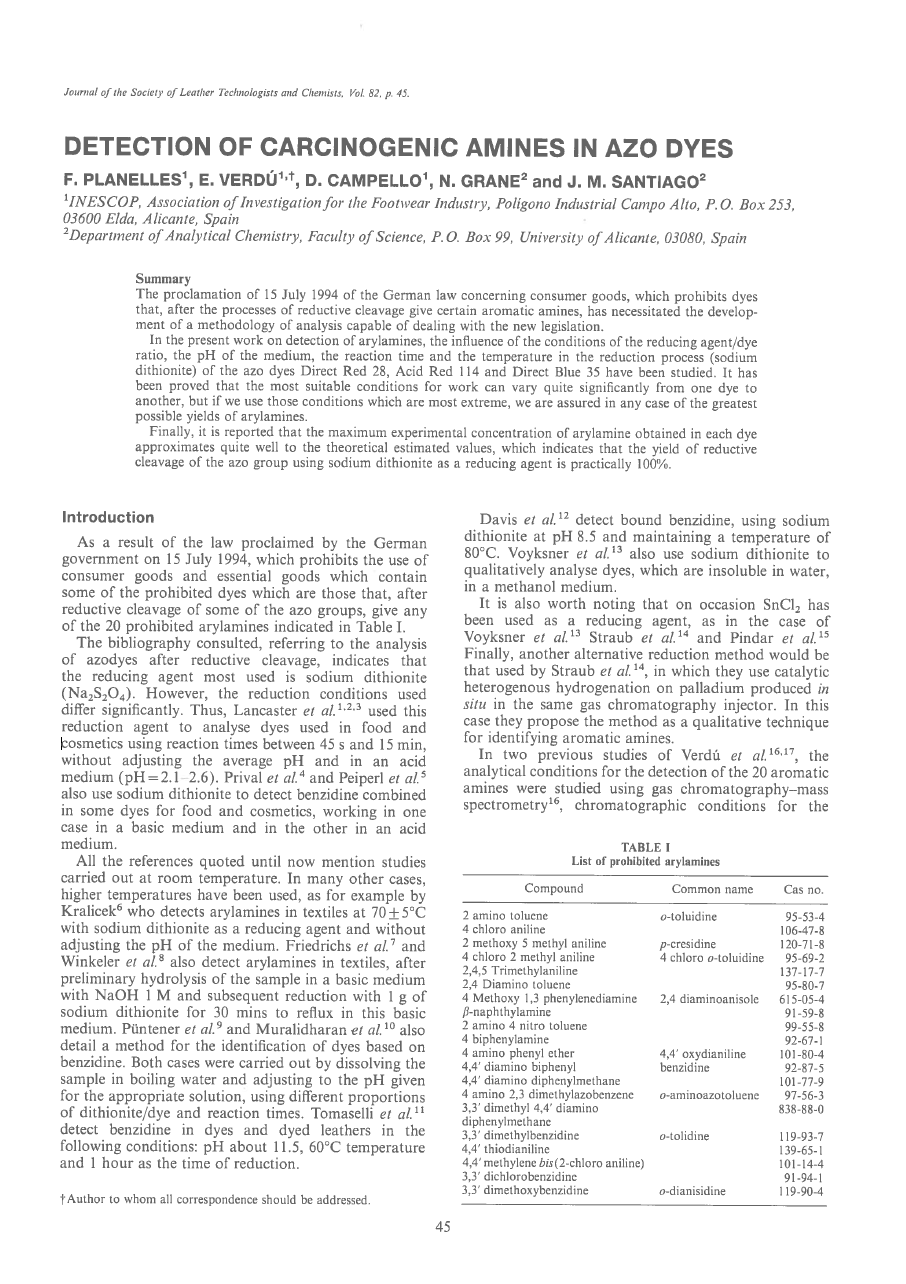
The proclamation of 15 July 1994 of the German law concerning consumer goods, which prohibits dyes that, after the processes of reductive cleavage give certain aromatic amines, has necessitated the develop ment of a methodology of analysis capable of dealing with the new legislation.
In the present work on detection of arylamines, the influence of the conditions of the reducing agent/dye ratio, the pH of the medium, the reaction time and the temperature in the reduction process (sodium dithionite) of the azo dyes Direct Red 28, Acid Red 114 and Direct Blue 35 have been studied. It has been proved that the most suitable conditions for work can vary quite significantly from one dye to another, but if we use those conditions which are most extreme, we are assured in any case of the greatest possible yields of arylamines.
Finally, it is reported that the maximum experimental concentration of arylamine obtained in each dye approximates quite well to the theoretical estimated values, which indicates that the yield of reductive cleavage of the azo group using sodium dithionite as a reducing agent is practically lO0/.
£20.00
Are you a member? Log in for access to the article.
Volume Number
82
Author(s)
F. PLANELLES; E. VERDU; D. CAMPELLO; N. GRANE; J. M. SANTIAGO
Detection Of Carcinogenic Amines In Azo Dyes
Volume Number
82
Author(s)
F. PLANELLES; E. VERDU; D. CAMPELLO; N. GRANE; J. M. SANTIAGO