Optimizing Methods Applied To Sheepskin Degreasing With Non-Ionic Surfactants
Abstract
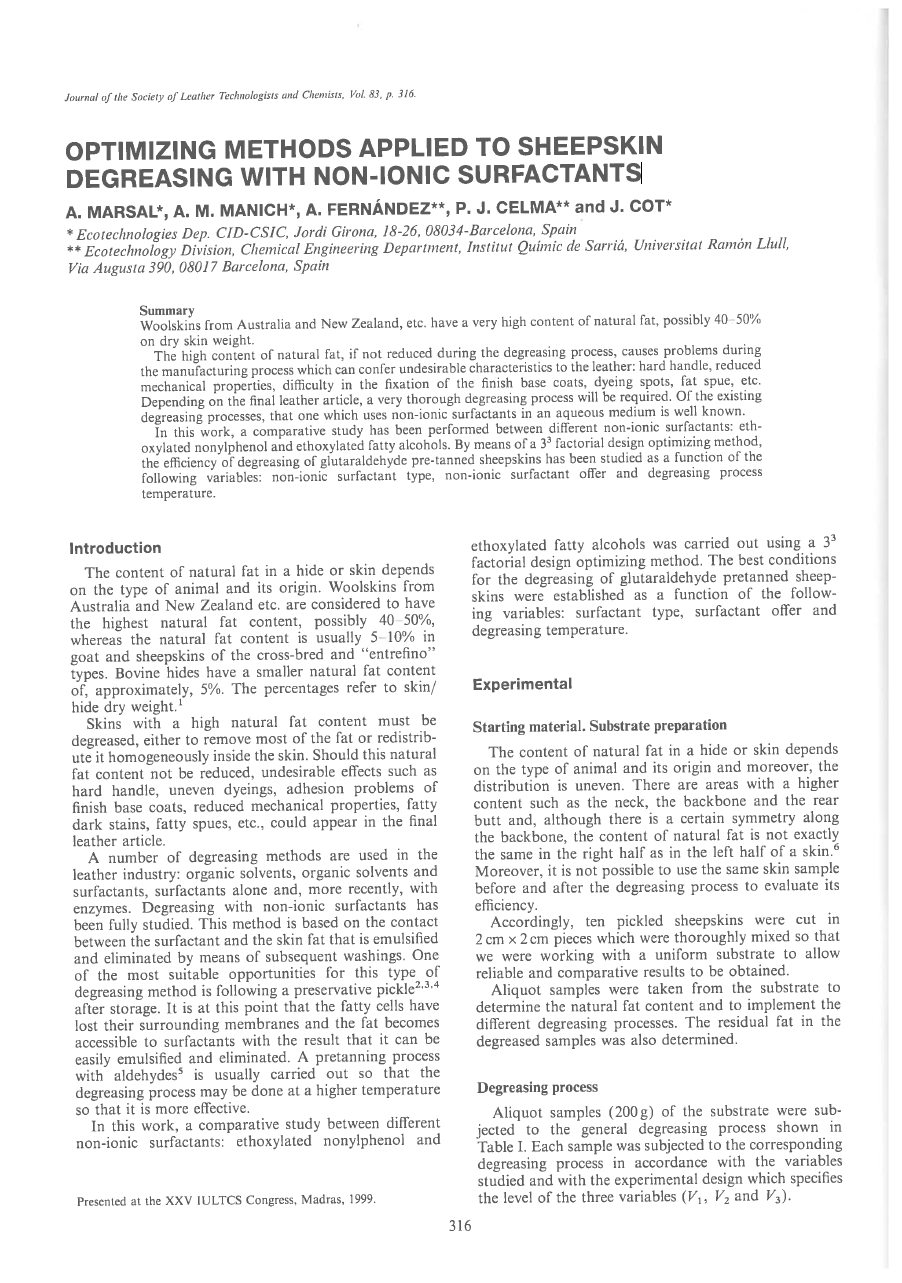
Woolskins from Australia and New Zealand, etc. have a very high content of natural fat, possibly 40—50% on dry skin weight.
The high content of natural fat, if not reduced during the degreasing process, causes problems during the manufacturing process which can confer undesirable characteristics to the leather: hard handle, reduced mechanical properties, difficulty in the fixation of the finish base coats, dyeing spots, fat spue, etc. Depending on the final leather article, a very thorough degreasing process will be required. Of the existing degreasing processes, that one which uses non-ionic surfactants in an aqueous medium is well known.
In this work, a comparative study has been performed between different non-ionic surfactants: eth oxylated nonylphenol and ethoxylated fatty alcohols. By means of a 33 factorial design optimizing method, the efficiency of degreasing of glutaraldehyde pre-tanned sheepskins has been studied as a function of the following variables: non-ionic surfactant type, non-ionic surfactant offer and degreasing process temperature.
£20.00
Are you a member? Log in for access to the article.
Volume Number
83
Author(s)
A. MARSAL; A. M. MANICH; A. FERNANDEZ; P. J. CELMA; J. COT
Optimizing Methods Applied To Sheepskin Degreasing With Non-Ionic Surfactants
Volume Number
83
Author(s)
A. MARSAL; A. M. MANICH; A. FERNANDEZ; P. J. CELMA; J. COT