The Cr.A.B. Process: A New Ecological Process For The Transformation Of Pickled Hides Into Leather Part 3: Fatliquoring
Abstract
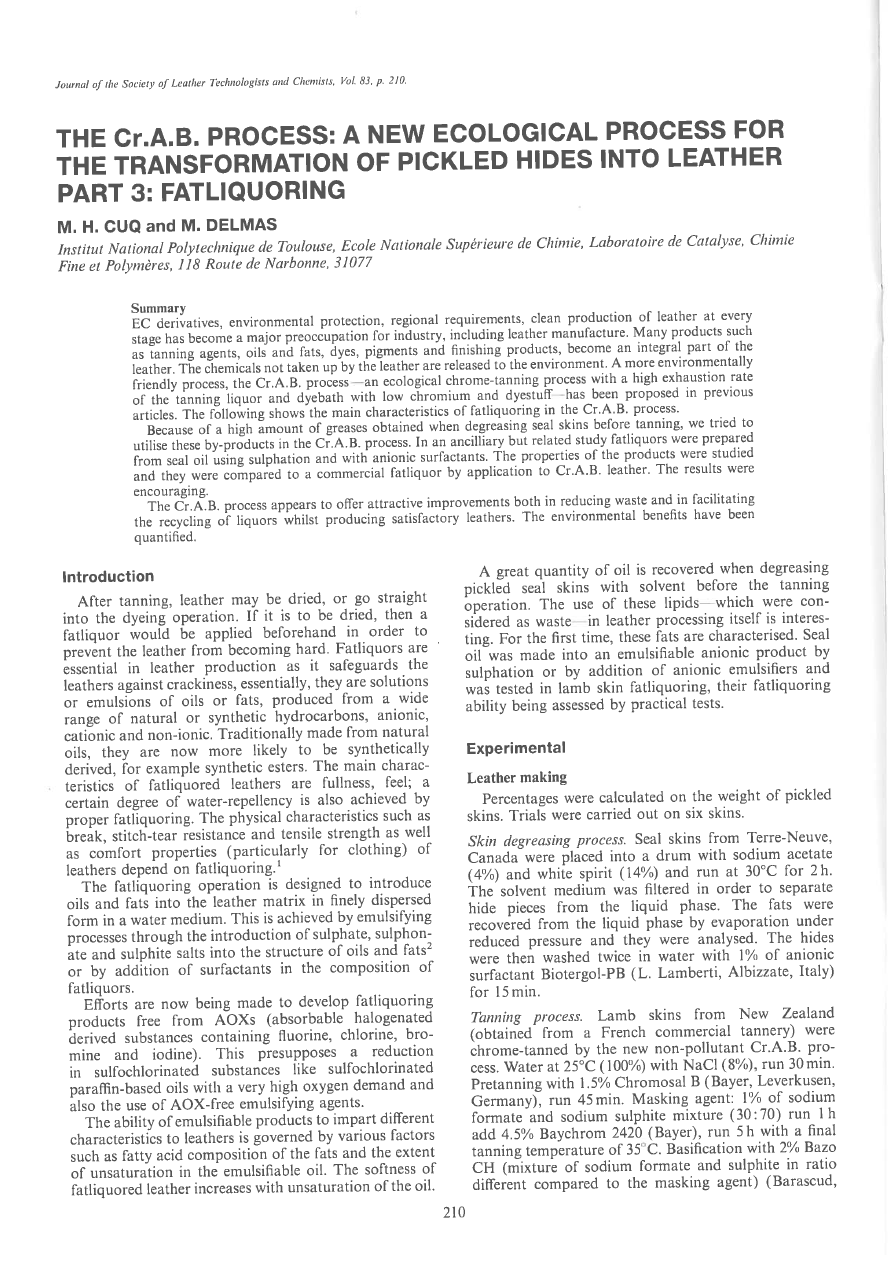
Summary EC derivatives, environmental protection. regional requirements, clean production of leather at every stage has become a major preoccupation for industry, including leather manufacture. Many products such as tanning agents, oils and fats, dyes, pigments and finishing products, become an integral part of the leather. The chemicals not taken up by the leather are released to the environment. A more environmentally friendly process, the Cr.A.B. process—an ecological chrome-tanning process with a high exhaustion rate of the tanning liquor and dyebath with low chromium and dyestuff —has been proposed in previous articles. The following shows the main characteristics of fatliquoring in the Cr.A.B. process.
Because of a high amount of greases obtained when degreasing seal skins before tanning, we tried to utilise these by-products in the Cr.A.B. process. In an ancilliary but related study fatliquors were prepared from seal oil using suiphation and with anionic surfactants. The properties of the products were studied and they were compared to a commercial fatliquor by application to Cr.A.B. leather. The results were encouraging.
The Cr.A.B. process appears to offer attractive improvements both in reducing waste and in facilitating the recycling of liquors whilst producing satisfactory leathers. The environmental benefits have been quantified.
£20.00
Are you a member? Log in for access to the article.
Volume Number
83
Author(s)
M. R. TOMKIN
The Cr.A.B. Process: A New Ecological Process For The Transformation Of Pickled Hides Into Leather Part 3: Fatliquoring