Adsorption Of Surfactants On Chromium Leather Waste
Abstract
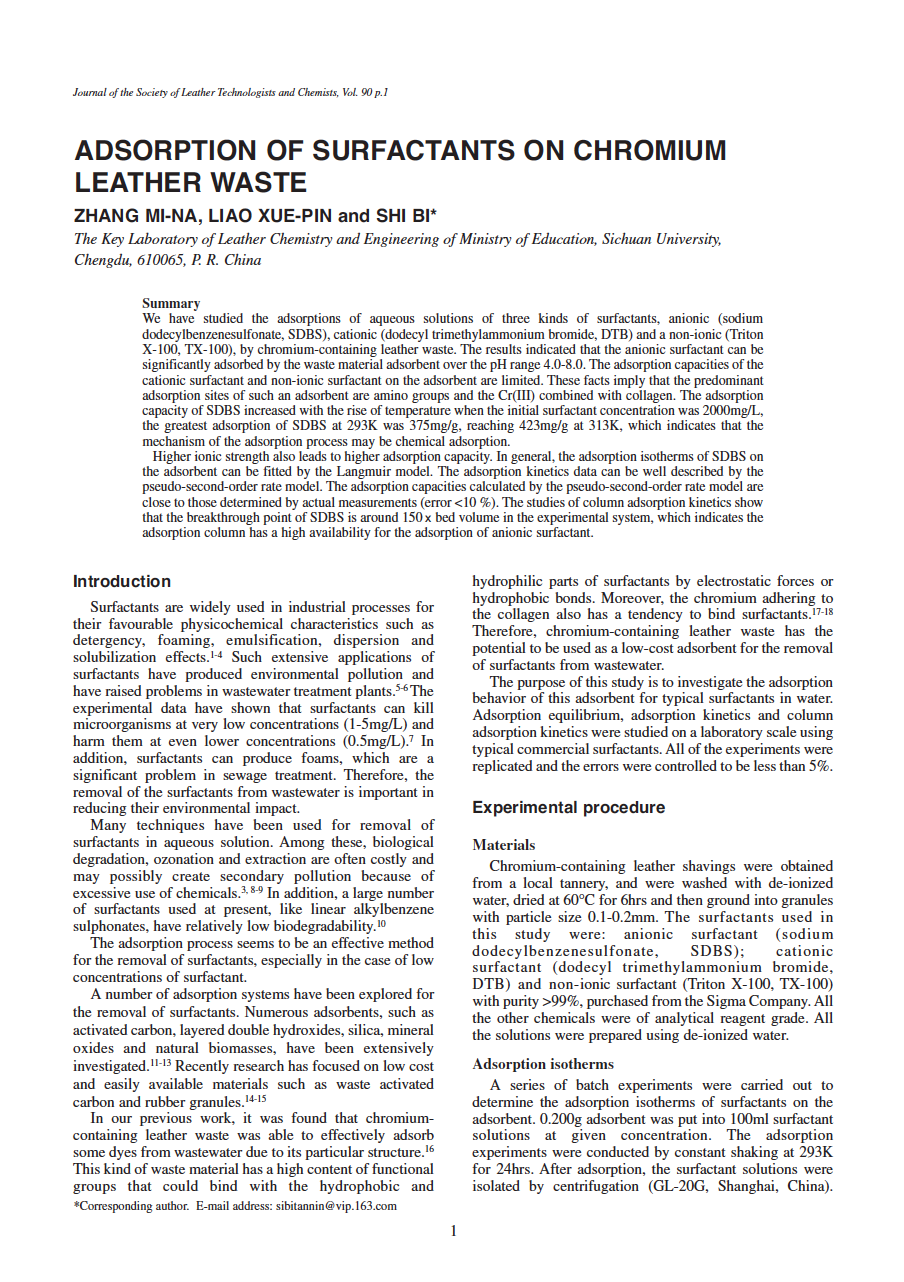
We have studied the adsorptions of aqueous solutions of three kinds of surfactants, anionic (sodium dodecylbenzenesulfonate, SDBS), cationic (dodecyl trimethylammonium bromide, DTB) and a non-ionic (Triton X-100, TX-100), by chromium-containing leather waste. The results indicated that the anionic surfactant can be significantly adsorbed by the waste material adsorbent over the pH range 4.0-8.0. The adsorption capacities of the cationic surfactant and non-ionic surfactant on the adsorbent are limited. These facts imply that the predominant adsorption sites of such an adsorbent are amino groups and the Cr(III) combined with collagen. The adsorption capacity of SDBS increased with the rise of temperature when the initial surfactant concentration was 2000mg/L, the greatest adsorption of SDBS at 293K was 375mg/g, reaching 423mg/g at 313K, which indicates that the mechanism of the adsorption process may be chemical adsorption.
Higher ionic strength also leads to higher adsorption capacity. In general, the adsorption isotherms of SDBS on the adsorbent can be fitted by the Langmuir model. The adsorption kinetics data can be well described by the pseudo-second-order rate model. The adsorption capacities calculated by the pseudo-second-order rate model are close to those determined by actual measurements (error <10 %). The studies of column adsorption kinetics show that the breakthrough point of SDBS is around 150 x bed volume in the experimental system, which indicates the adsorption column has a high availability for the adsorption of anionic surfactant.
£20.00
Are you a member? Log in for access to the article.
Volume Number
90
Author(s)
ZHANG MI-NA; LIAO XUE-PIN; SHI BI
Adsorption Of Surfactants On Chromium Leather Waste