
SLTC 2026 CONFERENCE 24TH-25TH APRIL – SAVE THE DATE
Abstract
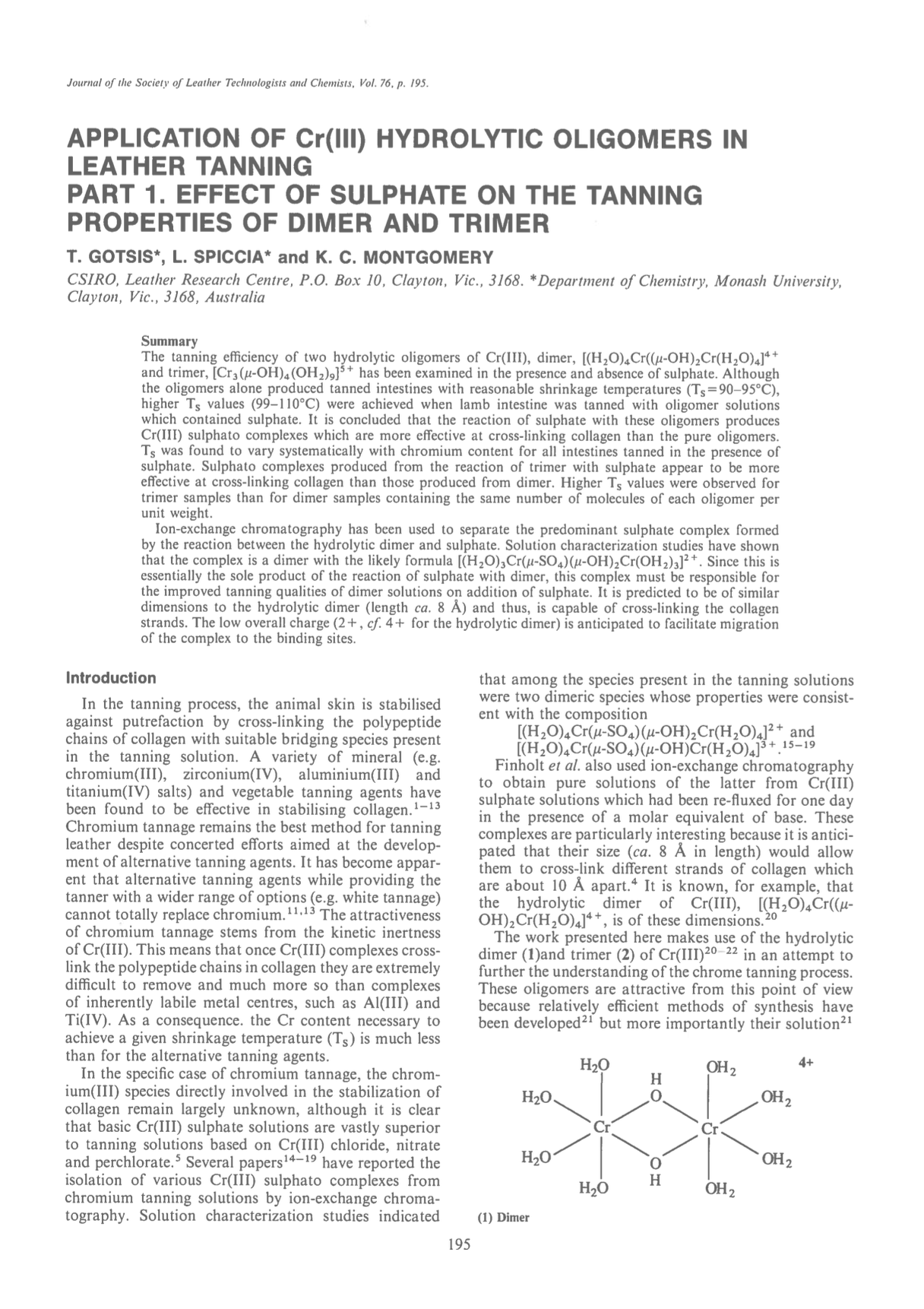
The tanning efficiency of two hydrolytic oligomers of Cr(III), dimer, [(H₂O)₄Cr((μ-OH)₂Cr(H₂O)₄]4+ and trimer, [Cr₃(μ-OH)₄(OH₂)₉]5+ has been examined in the presence and absence of sulphate. Although the oligomers alone produced tanned intestines with reasonable shrinkage temperatures (Ts = 90 – 95°C), higher Ts values (99 – 110°C) were achieved when lamb intestine was tanned with oligomer solutions which contained sulphate. It is concluded that the reaction of sulphate with these oligomers produces Cr(III) sulphato complexes which are more effective at cross-linking collagen than the pure oligomers. Ts was found to vary systematically with chromium content for all intestines tanned in the presence of sulphate. Sulphato complexes produced from the reaction of trimer with sulphate appear to be more effective at cross-linking collagen than those produced from dimer. Higher Ts values were observed for turner samples than for dimer samples containing the same number of molecules of each oligomer per unit weight. Ion-exchange chromatography has been used to separate the predominant sulphate complex formed by the reaction between the hydrolytic dimer and sulphate. Solution characterization studies have shown that the complex is a dimer with the likely formula [(H₂O)₃Cr(μ-SO₄)(μ-OH)₂Cr(OH₂)₃]2+. Since this is essentially the sole product of the reaction of sulphate with dimer, this complex must be responsible for the improved tanning qualities of dimer solutions on addition of sulphate. It is predicted to be of similar dimensions to the hydrolytic dimer (length ca. 8 Å) and thus, is capable of cross-linking the collagen strands. The low overall charge (2+, cf. 4+ for the hydrolytic dimer) is anticipated to facilitate migration of the complex to the binding sites.
£20.00
Are you a member? Log in for access to the article.