Application of N-(2-Hydroxy) Propyl-3-Trimethyl Ammonium Chitosan Chloride as an Antibacterial and Antifungal Agent in Wet-blue Cattle Hides
Abstract
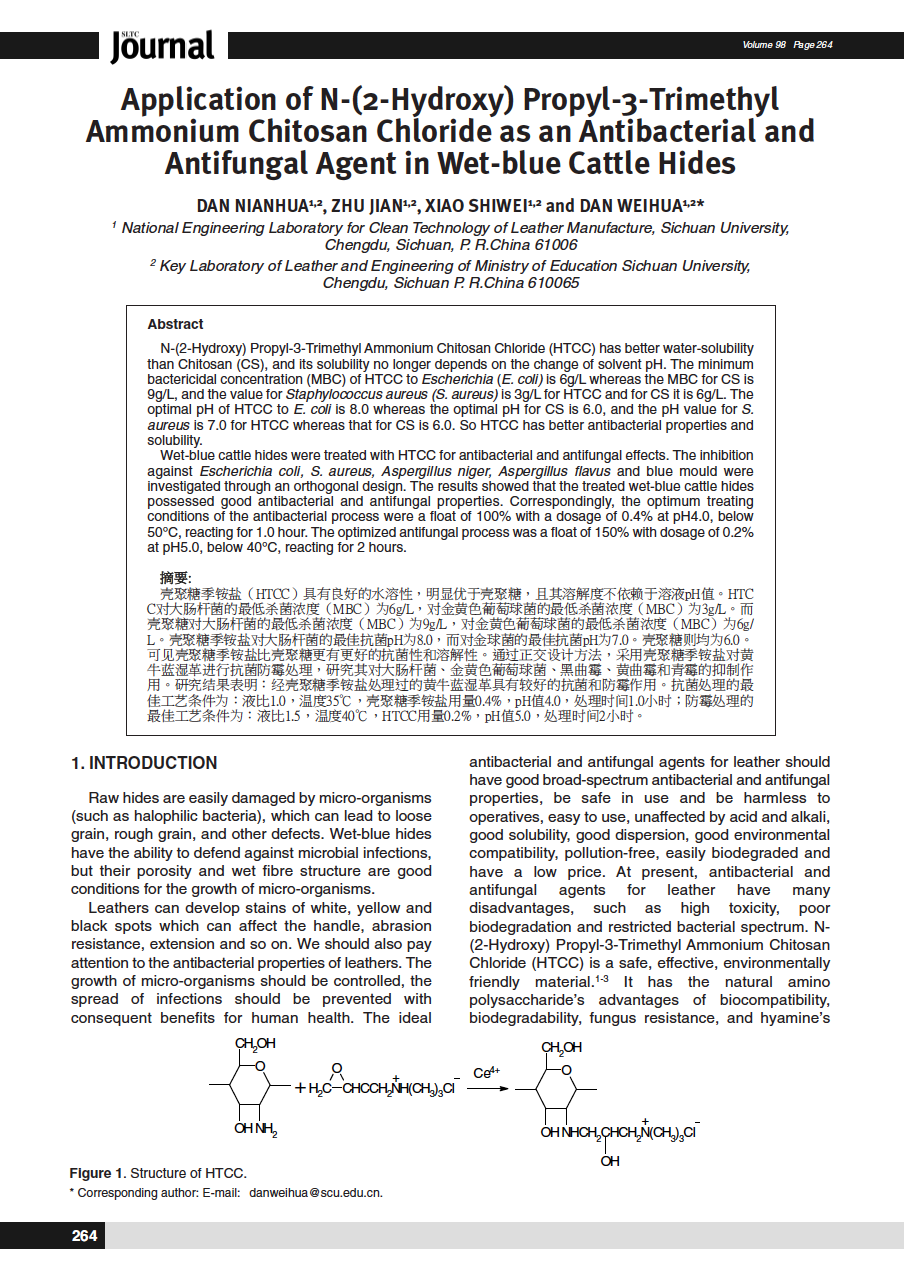
N-(2-Hydroxy) Propyl-3-Trimethyl Ammonium Chitosan Chloride (HTCC) has better water-solubility than Chitosan (CS), and its solubility no longer depends on the change of solvent pH. The minimum bactericidal concentration (MBC) of HTCC to Escherichia (E. coli) is 6g/L whereas the MBC for CS is 9g/L, and the value for Staphylococcus aureus (S. aureus) is 3g/L for HTCC and for CS it is 6g/L. The optimal pH of HTCC to E. coli is 8.0 whereas the optimal pH for CS is 6.0, and the pH value for S. aureus is 7.0 for HTCC whereas that for CS is 6.0. So HTCC has better antibacterial properties and solubility.
Wet-blue cattle hides were treated with HTCC for antibacterial and antifungal effects. The inhibition against Escherichia coli, S. aureus, Aspergillus niger, Aspergillus flavus and blue mould were investigated through an orthogonal design. The results showed that the treated wet-blue cattle hides possessed good antibacterial and antifungal properties. Correspondingly, the optimum treating conditions of the antibacterial process were a float of 100% with a dosage of 0.4% at pH4.0, below 50°C, reacting for 1.0 hour. The optimized antifungal process was a float of 150% with dosage of 0.2% at pH5.0, below 40°C, reacting for 2 hours.
£20.00
Are you a member? Log in for access to the article.
Volume Number
98
Author(s)
DAN NIANHUA; ZHU JIAN; XIAO SHIWEI; DAN WEIHUA
Application of N-(2-Hydroxy) Propyl-3-Trimethyl Ammonium Chitosan Chloride as an Antibacterial and Antifungal Agent in Wet-blue Cattle Hides