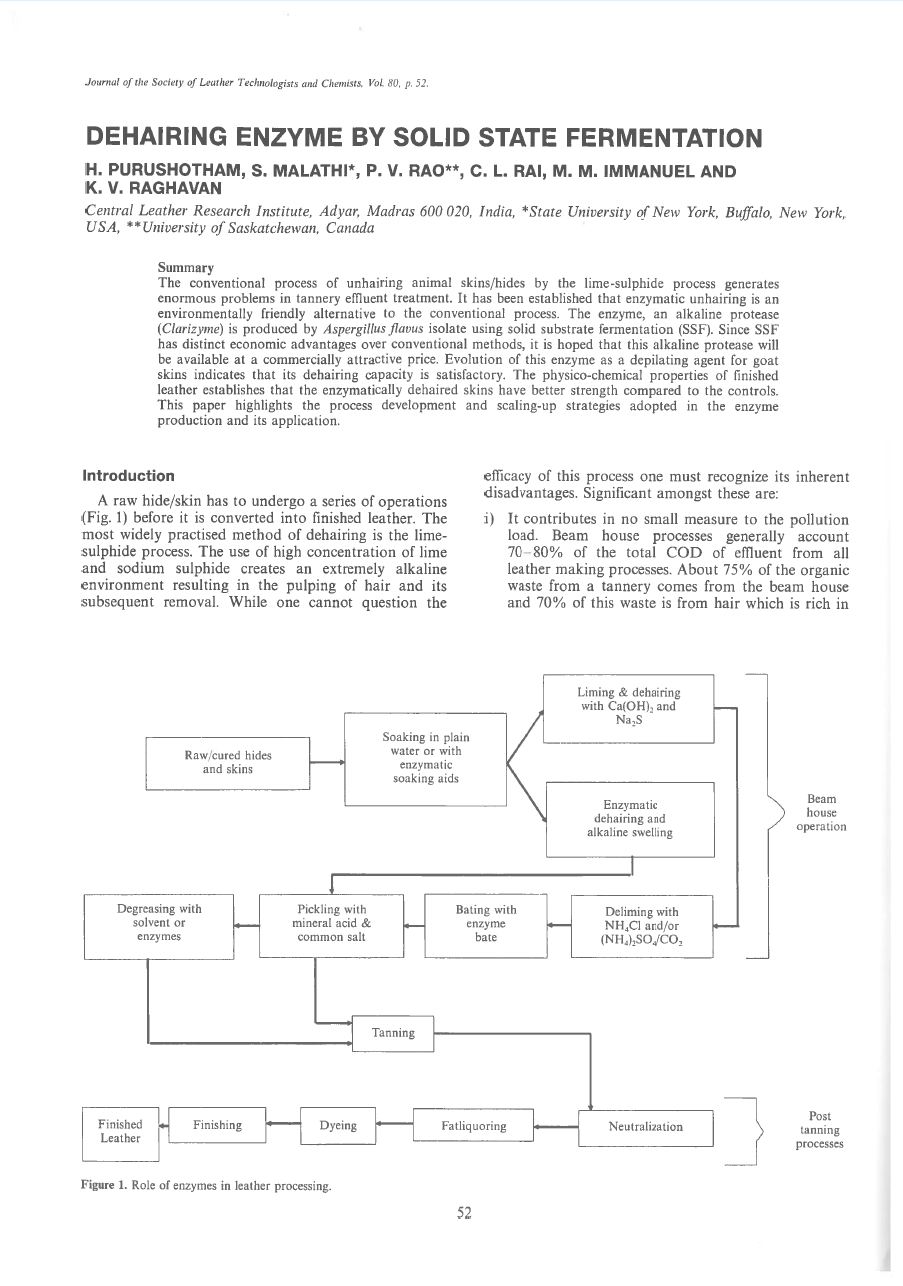
The conventional process of unhairing animal skins/hides by the lime-suiphide process generates enormous problems in tannery effluent treatment. It has been established that enzymatic unhairing is an environmentally friendly alternative to the conventional process. The enzyme, an alkaline protease (Clarizyme) is produced by Aspergillus flavus isolate using solid substrate fermentation (SSF). Since SSF has distinct economic advantages over conventional methods, it is hoped that this alkaline protease will be available at a commercially attractive price. Evolution of this enzyme as a depilating agent for goat skins indicates that its dehairing capacity is satisfactory. The physico-chemical properties of finished leather establishes that the enzymatically dehaired skins have better strength compared to the controls. This paper highlights the process development and scaling-up strategies adopted in the enzyme production and its application.
£20.00
Are you a member? Log in for access to the article.
Volume Number
80
Author(s)
H. PURUSHOTHAM; S. MALATHI; V. RAO; C. L. RAI; M. M. IMMANUEL; K. V. RAGHAVAN
Dehairing Enzyme By Solid State Fermentation
Volume Number
80
Author(s)
H. PURUSHOTHAM; S. MALATHI; V. RAO; C. L. RAI; M. M. IMMANUEL; K. V. RAGHAVAN