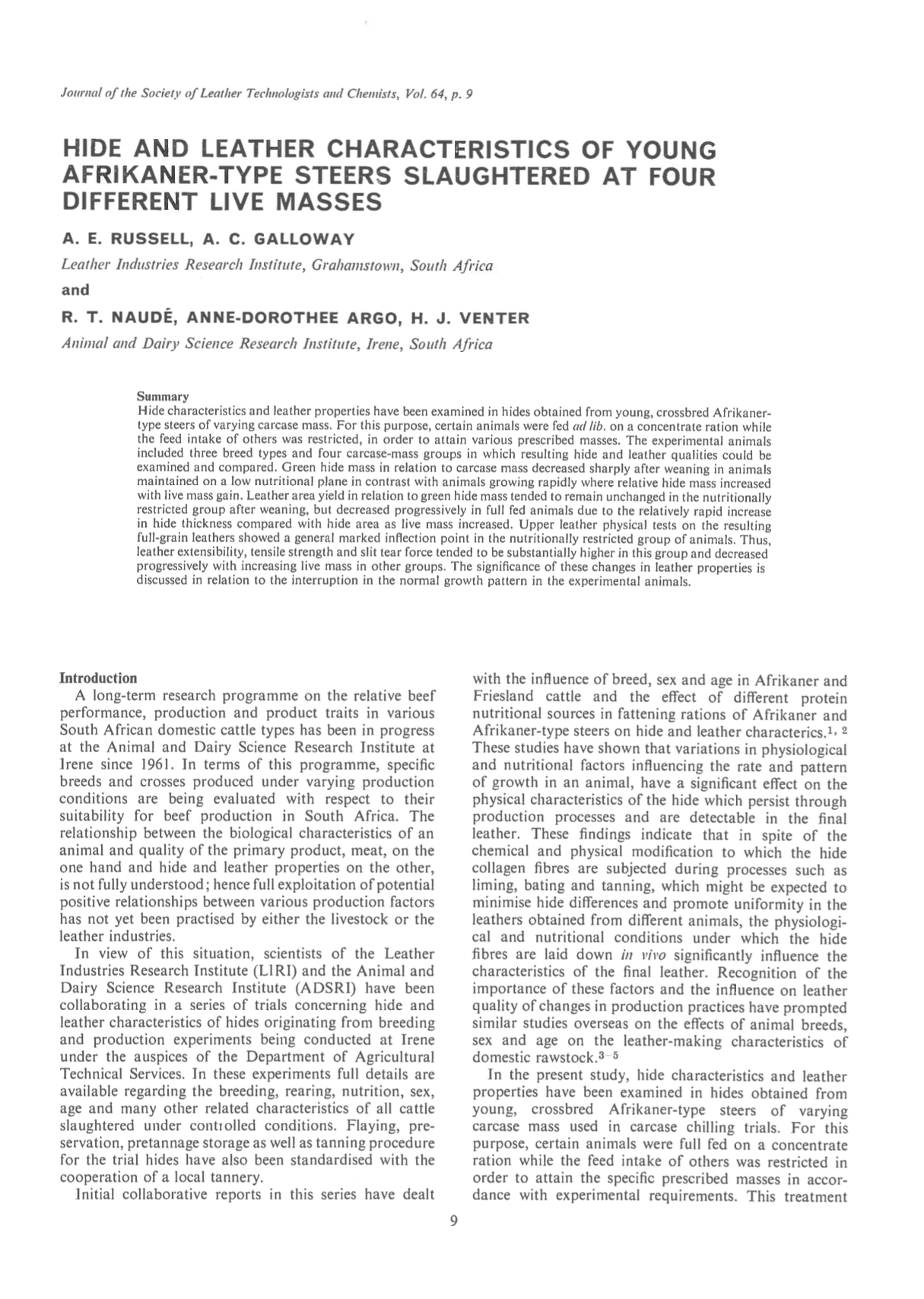
Hide And Leather Characteristics of Young Afrikaner-Type Steers Slaughtered at Four Different Live Masses
Abstract
Hide characteristics and leather properties have been examined in hides obtained from young, crossbred Afrikaner type steers of varying carcase mass. For this purpose, certain animals were fed ad lib. on a concentrate ration while the feed intake of others was restricted, in order to attain various prescribed masses. The experimental animals included three breed types and four carcase-mass groups in which resulting hide and leather qualities could be examined and compared. Green hide mass in relation to carcase mass decreased sharply after weaning in animals maintained on a low nutritional plane in contrast with animals growing rapidly where relative hide mass increased with live mass gain. Leather area yield in relation to green hide mass tended to remain unchanged in the nutritionally restricted group after weaning, but decreased progressively in full fed animals due to the relatively rapid increase in hide thickness compared with hide area as live mass increased. Upper leather physical tests on the resulting full-grain leathers showed a general marked inflection point in the nutritionally restricted group of animals. Thus, leather extensibility, tensile strength and slit tear force tended to be substantially higher in this group and decreased progressively with increasing live mass in other groups. The significance of these changes in leather properties is discussed in relation to the interruption in the normal growth pattern in the experimental animals.
£20.00
Are you a member? Log in for access to the article.
Volume Number
64
Author(s)
A.E. RUSSELL; A.C. GALLOWAY; R.T. NAUDE; ANNE-DOROTHEE ARGO; H.J. VENTER
Hide And Leather Characteristics of Young Afrikaner-Type Steers Slaughtered at Four Different Live Masses
Volume Number
64
Author(s)
A.E. RUSSELL; A.C. GALLOWAY; R.T. NAUDE; ANNE-DOROTHEE ARGO; H.J. VENTER