Interaction Of Aldehyde Developed From Amino Acids Of Tannery Waste In A Lowerchrome Tannage: An Eco-Friendly Approach
Abstract
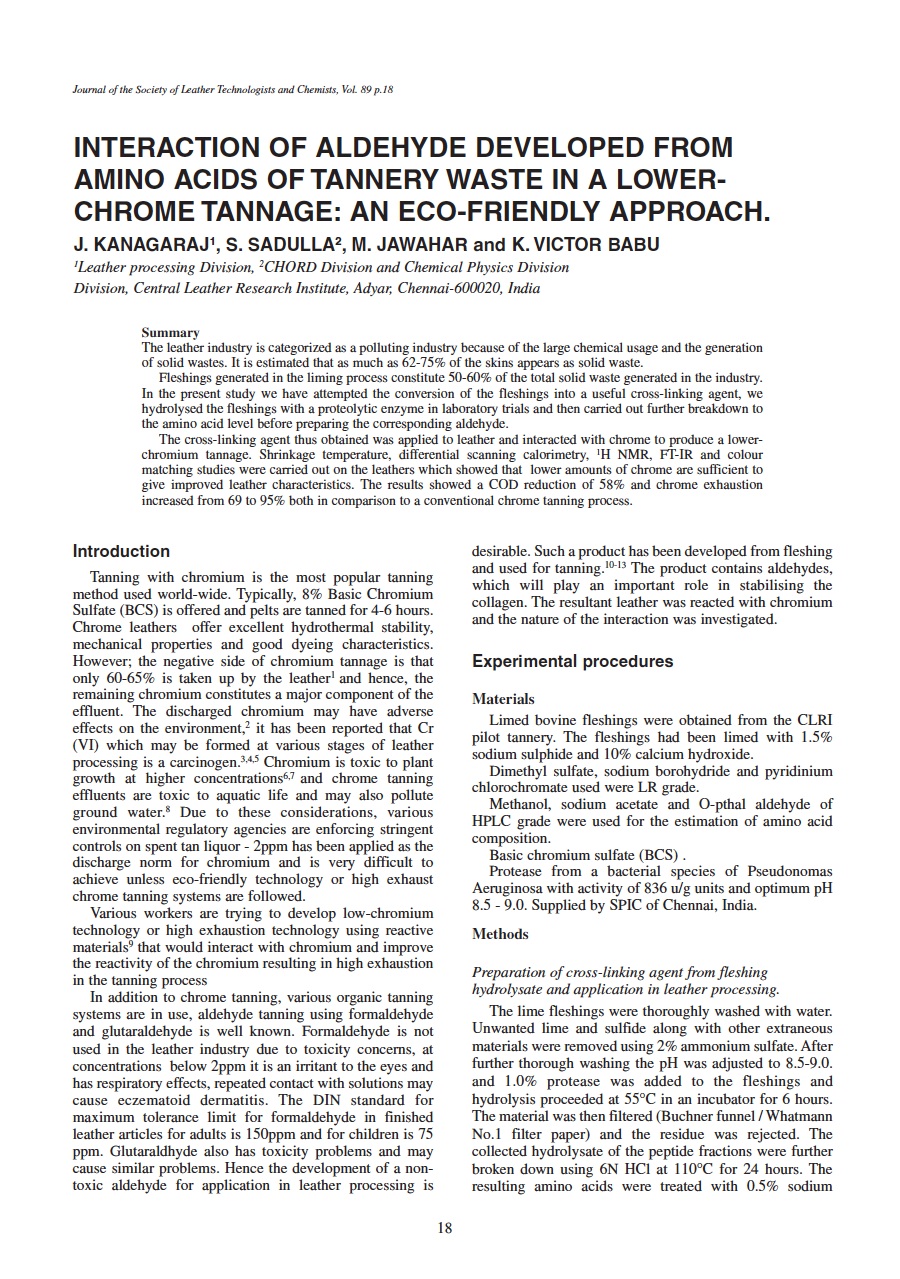
The leather industry is categorized as a polluting industry because of the large chemical usage and the generation of solid wastes. It is estimated that as much as 62-75% of the skins appears as solid waste.
Fleshings generated in the liming process constitute 50-60% of the total solid waste generated in the industry. In the present study we have attempted the conversion of the fleshings into a useful cross-linking agent, we hydrolysed the fleshings with a proteolytic enzyme in laboratory trials and then carried out further breakdown to the amino acid level before preparing the corresponding aldehyde.
The cross-linking agent thus obtained was applied to leather and interacted with chrome to produce a lowerchromium tannage. Shrinkage temperature, differential scanning calorimetry, 1H NMR, FT-IR and colour matching studies were carried out on the leathers which showed that lower amounts of chrome are sufficient to give improved leather characteristics. The results showed a COD reduction of 58% and chrome exhaustion increased from 69 to 95% both in comparison to a conventional chrome tanning process.
£20.00
Are you a member? Log in for access to the article.
Volume Number
89
Author(s)
J. KANAGARAJ; S. SADULLA; M. JAWAHAR; K. VICTOR BABU
Interaction Of Aldehyde Developed From Amino Acids Of Tannery Waste In A Lowerchrome Tannage: An Eco-Friendly Approach
Volume Number
89
Author(s)
J. KANAGARAJ; S. SADULLA; M. JAWAHAR; K. VICTOR BABU