Investigation Of Tartaric Acid/Copper Sulphate Mixture As A Light Stabilizer In Leather Dyeing
Abstract
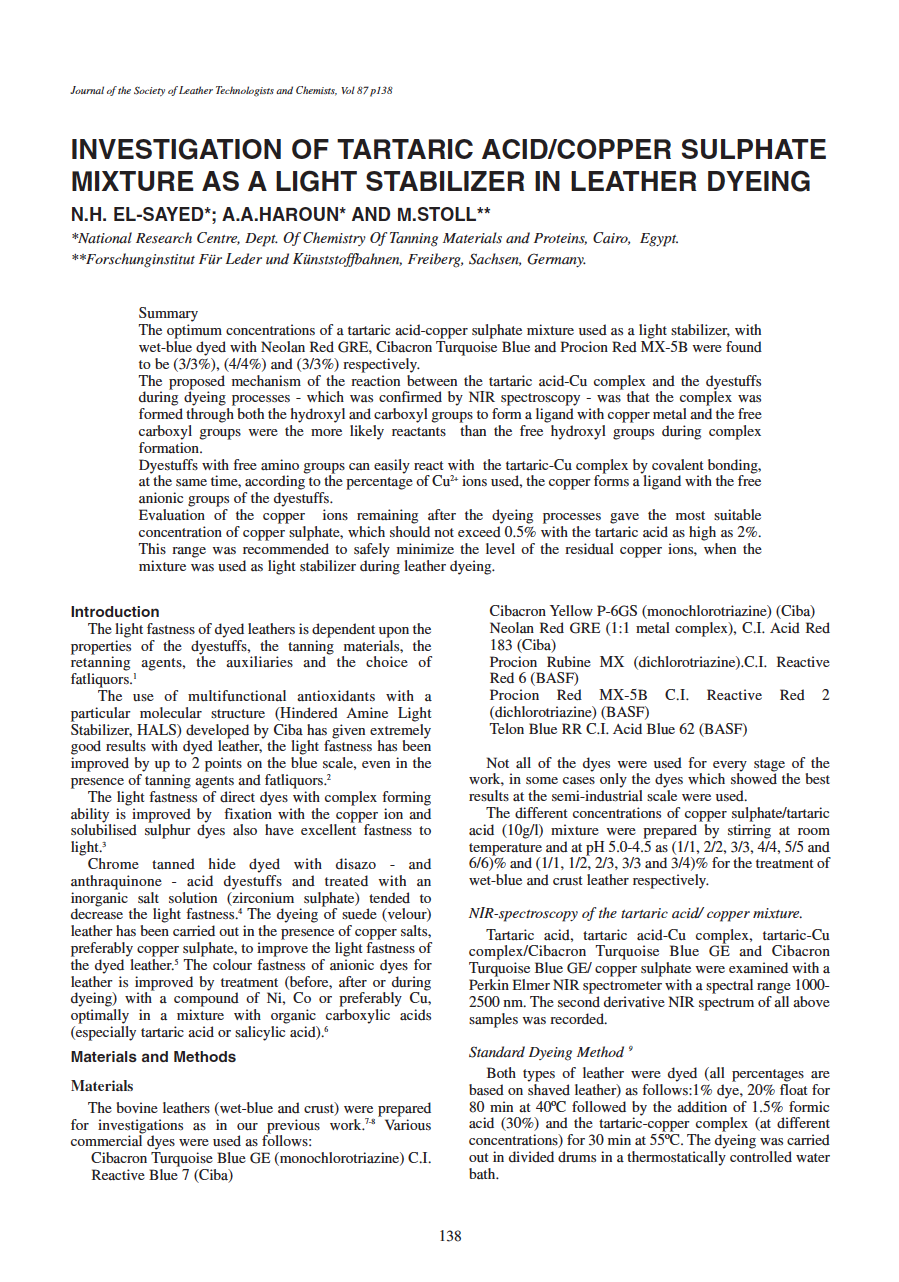
The optimum concentrations of a tartaric acid-copper sulphate mixture used as a light stabilizer, with wet-blue dyed with Neolan Red GRE, Cibacron Turquoise Blue and Procion Red MX-5B were found to be (3/3%), (4/4%) and (3/3%) respectively. The proposed mechanism of the reaction between the tartaric acid-Cu complex and the dyestuffs during dyeing processes – which was confirmed by NIR spectroscopy – was that the complex was formed through both the hydroxyl and carboxyl groups to form a ligand with copper metal and the free carboxyl groups were the more likely reactants than the free hydroxyl groups during complex formation.
Dyestuffs with free amino groups can easily react with the tartaric-Cu complex by covalent bonding, at the same time, according to the percentage of Cu2+ ions used, the copper forms a ligand with the free anionic groups of the dyestuffs.
Evaluation of the copper ions remaining after the dyeing processes gave the most suitable concentration of copper sulphate, which should not exceed 0.5% with the tartaric acid as high as 2%. This range was recommended to safely minimize the level of the residual copper ions, when the mixture was used as light stabilizer during leather dyeing.
£20.00
Are you a member? Log in for access to the article.
Volume Number
87
Author(s)
N.H. EL-SAYED; A.A.HAROUN; M.STOLL
Investigation Of Tartaric Acid/Copper Sulphate Mixture As A Light Stabilizer In Leather Dyeing