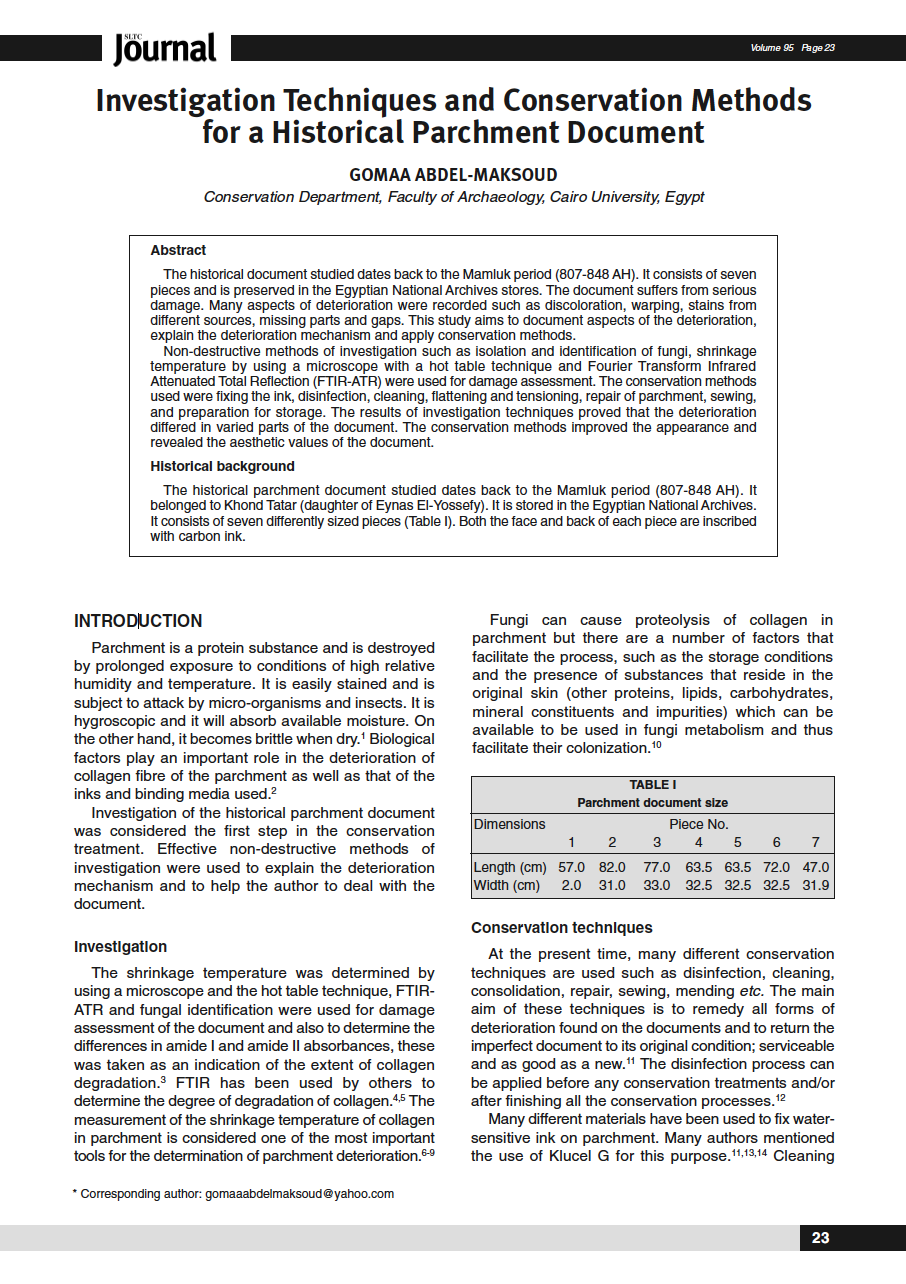
Investigation Techniques and Conservation Methods for a Historical Parchment Document
Abstract
The historical document studied dates back to the Mamluk period (807-848 AH). It consists of seven pieces and is preserved in the Egyptian National Archives stores. The document suffers from serious damage. Many aspects of deterioration were recorded such as discoloration, warping, stains from different sources, missing parts and gaps. This study aims to document aspects of the deterioration, explain the deterioration mechanism and apply conservation methods.
Non-destructive methods of investigation such as isolation and identification of fungi, shrinkage temperature by using a microscope with a hot table technique and Fourier Transform Infrared Attenuated Total Reflection (FTIR-ATR) were used for damage assessment. The conservation methods used were fixing the ink, disinfection, cleaning, flattening and tensioning, repair of parchment, sewing, and preparation for storage. The results of investigation techniques proved that the deterioration differed in varied parts of the document. The conservation methods improved the appearance and revealed the aesthetic values of the document.
Historical background
The historical parchment document studied dates back to the Mamluk period (807-848 AH). It belonged to Khond Tatar (daughter of Eynas El-Yossefy). It is stored in the Egyptian National Archives. It consists of seven differently sized pieces (Table I). Both the face and back of each piece are inscribed with carbon ink.
£20.00
Are you a member? Log in for access to the article.
Volume Number
95
Author(s)
GOMAA ABDEL-MAKSOUD
Investigation Techniques and Conservation Methods for a Historical Parchment Document