Leather Ageing And Hexavalent Chromium Formation As A Function Of The Fatliquoring Agent. Part II: Chrome Retanned Leathers
Abstract
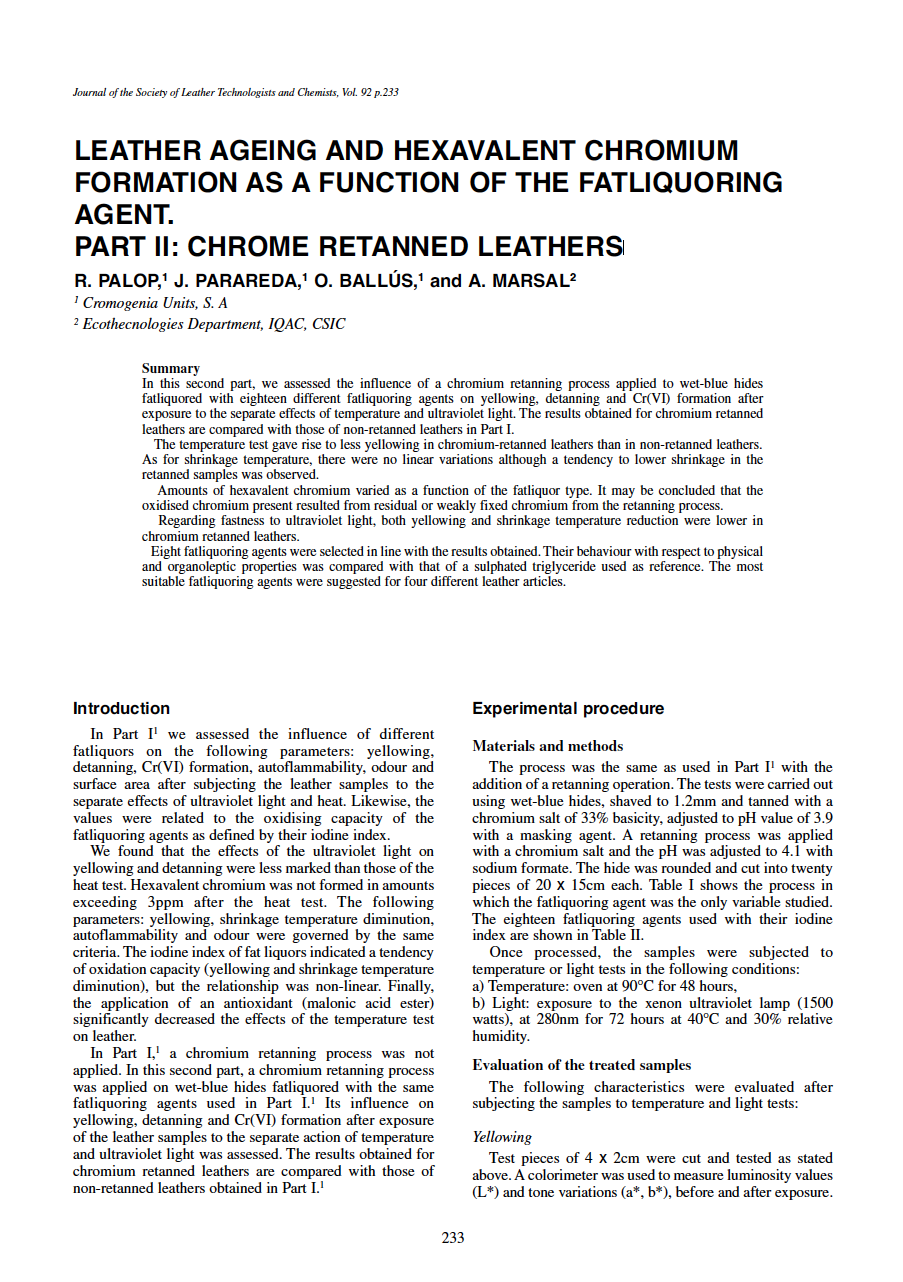
In this second part, we assessed the influence of a chromium retanning process applied to wet-blue hides fatliquored with eighteen different fatliquoring agents on yellowing, detanning and Cr(VI) formation after exposure to the separate effects of temperature and ultraviolet light. The results obtained for chromium retanned leathers are compared with those of non-retanned leathers in Part I.
The temperature test gave rise to less yellowing in chromium-retanned leathers than in non-retanned leathers. As for shrinkage temperature, there were no linear variations although a tendency to lower shrinkage in the retanned samples was observed.
Amounts of hexavalent chromium varied as a function of the fatliquor type. It may be concluded that the oxidised chromium present resulted from residual or weakly fixed chromium from the retanning process. Regarding fastness to ultraviolet light, both yellowing and shrinkage temperature reduction were lower in chromium retanned leathers.
Eight fatliquoring agents were selected in line with the results obtained. Their behaviour with respect to physical and organoleptic properties was compared with that of a sulphated triglyceride used as reference. The most suitable fatliquoring agents were suggested for four different leather articles.
£20.00
Are you a member? Log in for access to the article.
Volume Number
92
Author(s)
R. PALOP; J. PARAREDA; O. BALLÚS; A. MARSAL
Leather Ageing And Hexavalent Chromium Formation As A Function Of The Fatliquoring Agent. Part II: Chrome Retanned Leathers