Modification Of Chrome-Tanned Leather Waste Hydrolysate With Epichlorhydrin
Abstract
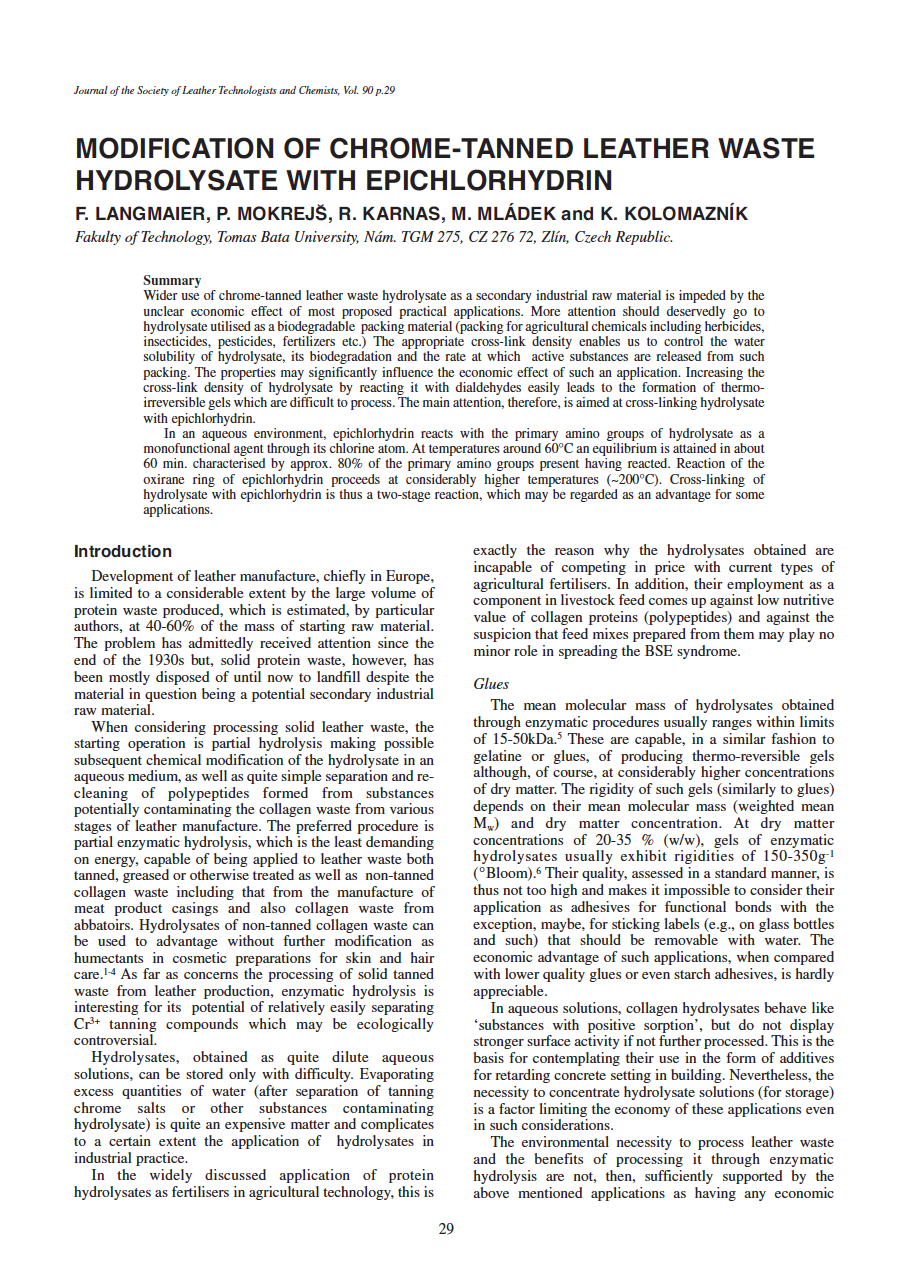
Wider use of chrome-tanned leather waste hydrolysate as a secondary industrial raw material is impeded by the unclear economic effect of most proposed practical applications. More attention should deservedly go to hydrolysate utilised as a biodegradable packing material (packing for agricultural chemicals including herbicides, insecticides, pesticides, fertilizers etc.) The appropriate cross-link density enables us to control the water solubility of hydrolysate, its biodegradation and the rate at which active substances are released from such packing. The properties may significantly influence the economic effect of such an application. Increasing the cross-link density of hydrolysate by reacting it with dialdehydes easily leads to the formation of thermoirreversible gels which are difficult to process. The main attention, therefore, is aimed at cross-linking hydrolysate with epichlorhydrin.
In an aqueous environment, epichlorhydrin reacts with the primary amino groups of hydrolysate as a monofunctional agent through its chlorine atom. At temperatures around 60°C an equilibrium is attained in about 60 min. characterised by approx. 80% of the primary amino groups present having reacted. Reaction of the oxirane ring of epichlorhydrin proceeds at considerably higher temperatures (~200°C). Cross-linking of hydrolysate with epichlorhydrin is thus a two-stage reaction, which may be regarded as an advantage for some applications.
£20.00
Are you a member? Log in for access to the article.
Volume Number
90
Author(s)
F. LANGMAIER; P. MOKREJS; R. KARNAS; M. MLÁDEK; K. KOLOMAZNÍK
Modification Of Chrome-Tanned Leather Waste Hydrolysate With Epichlorhydrin
Volume Number
90
Author(s)
F. LANGMAIER; P. MOKREJS; R. KARNAS; M. MLÁDEK; K. KOLOMAZNÍK