Relationship of Leather Break to Grain and Flesh Layers Stress-Strain Properties
Abstract
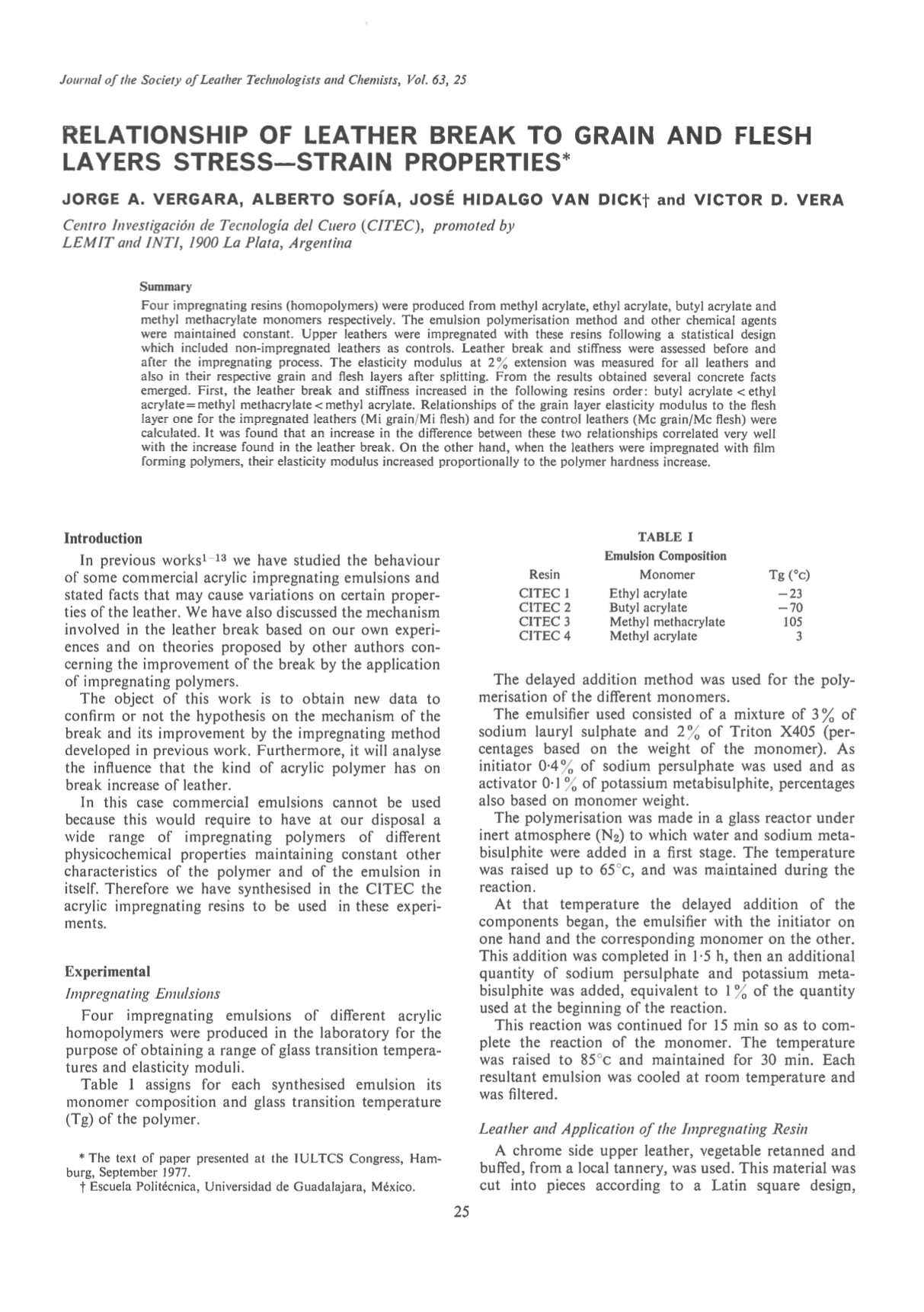
Four impregnating resins (homopolymers) were produced from methyl acrylate, ethyl acrylate, butyl acrylate and methyl methacrylate monomers respectively. The emulsion polymerisation method and other chemical agents were maintained constant. Upper leathers were impregnated with these resins following a statistical design which included non-impregnated leathers as controls. Leather break and stiffness were assessed before and after the impregnating process. The elasticity modulus at 2% extension was measured for all leathers and also in their respective grain and flesh layers after splitting. From the results obtained several concrete facts emerged. First, the leather break and stiffness increased in the following resins order: butyl acrylate < ethyl acrylate = methyl methacrylate < methyl acrylate. Relationships of the grain layer elasticity modulus to the flesh layer one for the impregnated leathers (Mi grain/Mi flesh) and for the control leathers (Mc grain/Mc flesh) were calculated. It was found that an increase in the difference between these two relationships correlated very well with the increase found in the leather break. On the other hand, when the leathers were impregnated with film forming polymers, their elasticity modulus increased proportionally to the polymer hardness increase.
£20.00
Are you a member? Log in for access to the article.
Volume Number
63
Author(s)
JORGE A. VERGARA; ALBERTO SOFIA; JOSÉ HIDALGO VAN DICK; VICTOR D. VERA
Relationship of Leather Break to Grain and Flesh Layers Stress-Strain Properties
Volume Number
63
Author(s)
JORGE A. VERGARA; ALBERTO SOFIA; JOSÉ HIDALGO VAN DICK; VICTOR D. VERA