Studies on the Shrinkage Temperature and Mechanical Properties of Gamma-Irradiated Sheepskin Splits
Abstract
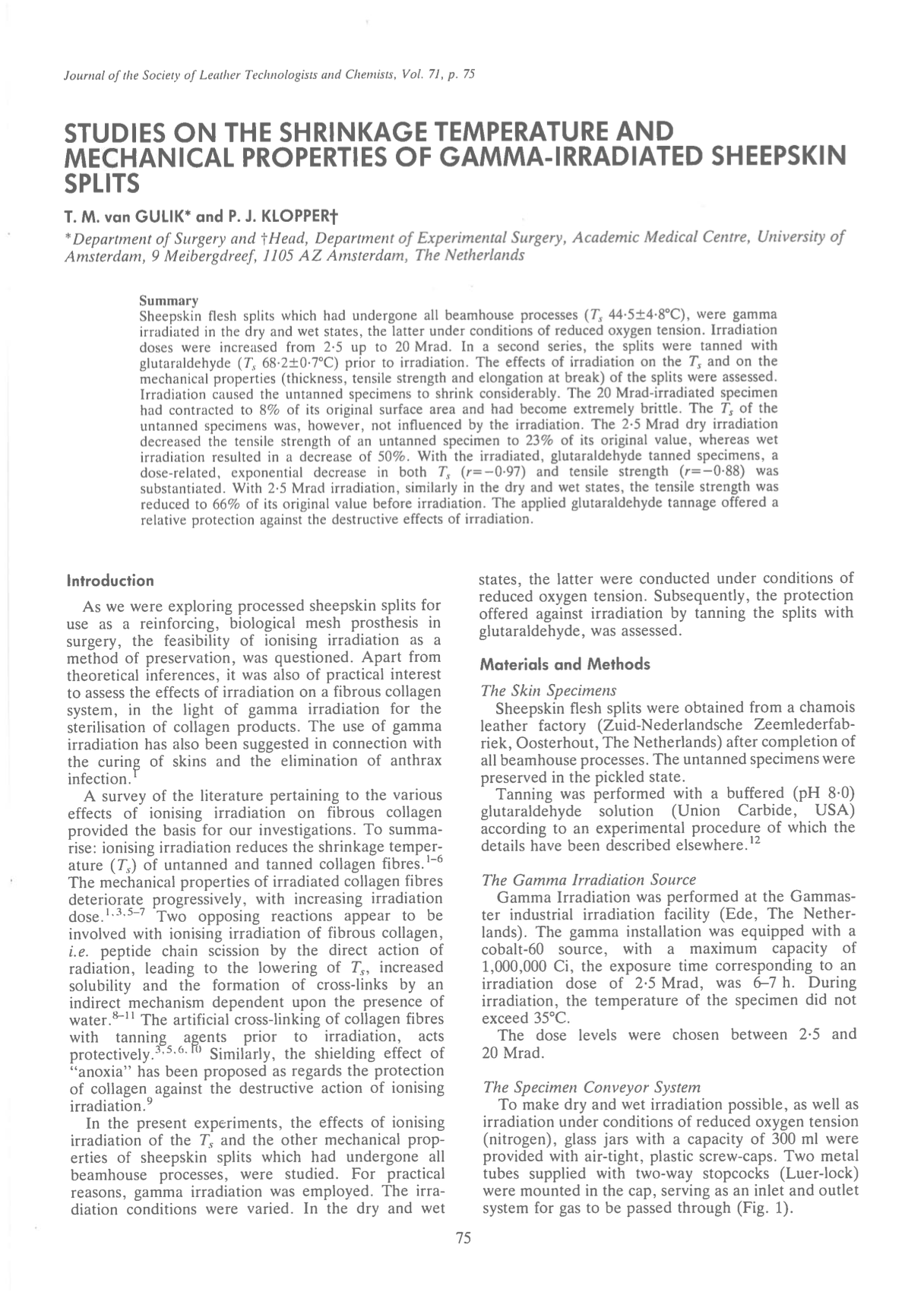
Sheepskin flesh splits which had undergone all beamhouse processes (Ts 44.5±4.8°C), were gamma irradiated in the dry and wet states, the latter under conditions of reduced oxygen tension. Irradiation doses were increased from 2.5 up to 20 Mrad. In a second series, the splits were tanned with glutaraldehyde (Ts 68.2±0.7°C) prior to irradiation. The effects of irradiation on the Ts and on the mechanical properties (thickness, tensile strength and elongation at break) of the splits were assessed. Irradiation caused the untanned specimens to shrink considerably. The 20 Mrad-irradiated specimen had contracted to 8% of its original surface area and had become extremely brittle. The Ts of the untanned specimens was, however, not influenced by the irradiation. The 2.5 Mrad dry irradiation decreased the tensile strength of an untanned specimen to 23% of its original value, whereas wet irradiation resulted in a decrease of 50%. With the irradiated, glutaraldehyde tanned specimens, a dose-related, exponential decrease in both Ts (r = -0.97) and tensile strength (r = -0.88) was substantiated. With 25 Mrad irradiation, similarly in the dry and wet states, the tensile strength was reduced to 66% of its original value before irradiation. The applied glutaraldehyde tannage offered a relative protection against the destructive effects of irradiation.
£20.00
Are you a member? Log in for access to the article.
Volume Number
71
Author(s)
T. M. van GULIK; P. J. KLOPPER
Studies on the Shrinkage Temperature and Mechanical Properties of Gamma-Irradiated Sheepskin Splits