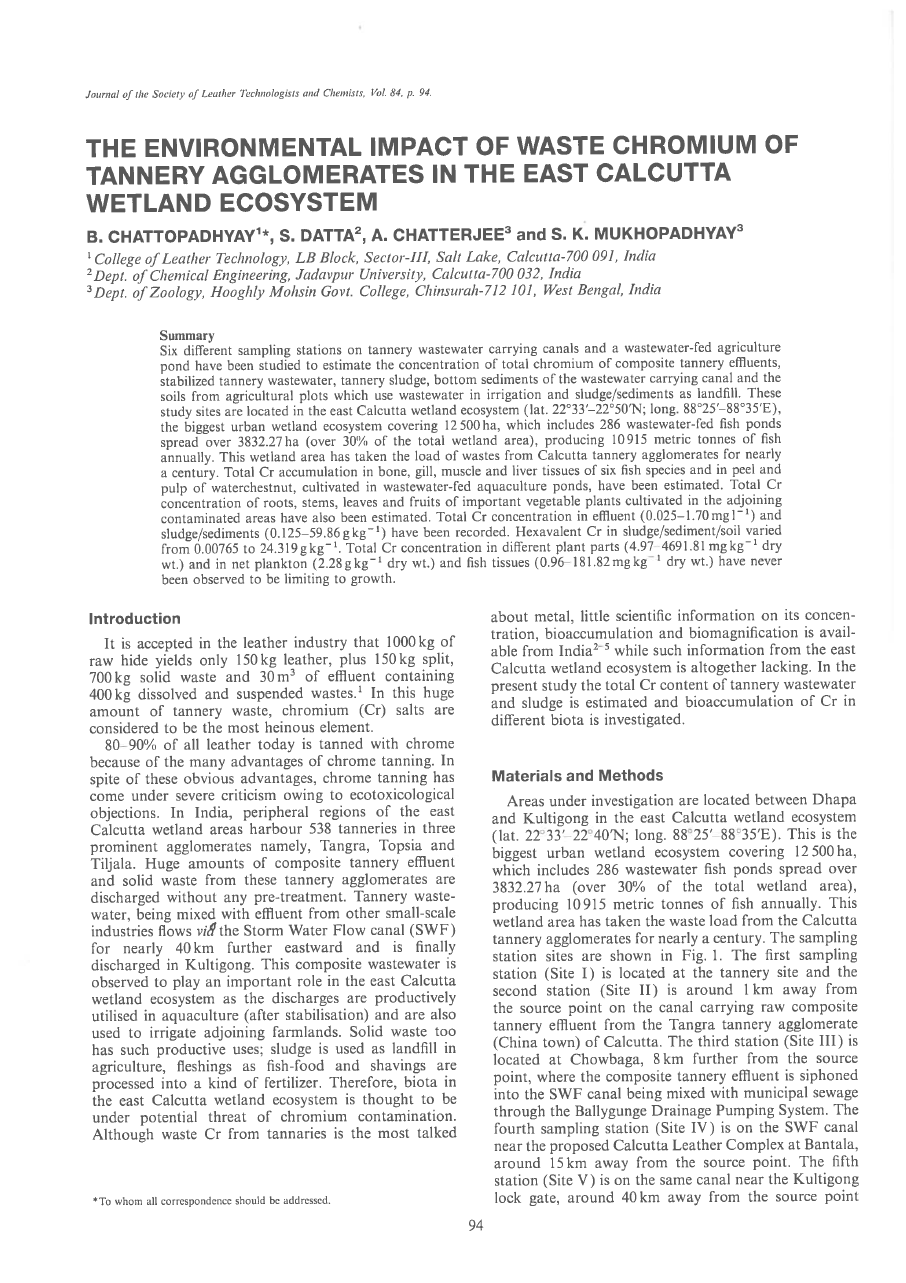
The Environmental Impact Of Waste Chromium Of Tannery Agglomerates In The East Calcutta Wetland Ecosystem
Abstract
Six different sampling stations on tannery wastewater carrying canals and a wastewater-fed agriculture pond have been studied to estimate the concentration of total chromium of composite tannery effluents, stabilized tannery wastewater, tannery sludge, bottom sediments of the wastewater carrying canal and the soils from agricultural plots which use wastewater in irrigation and sludge/sediments as landfill. These study sites are located in the east Calcutta wetland ecosystem (lat. 22°33′-22°50′N; long. 88°25′-88°35′E), the biggest urban wetland ecosystem covering 12500 ha, which includes 286 wastewater-fed fish ponds spread over 3832.27 ha (over 30% of the total wetland area), producing 10915 metric tonnes of fish annually. This wetland area has taken the load of wastes from Calcutta tannery agglomerates for nearly a century. Total Cr accumulation in bone, gill, muscle and liver tissues of six fish species and in peel and pulp of waterchestnut, cultivated in wastewater-fed aquaculture ponds, have been estimated. Total Cr concentration of roots, stems, leaves and fruits of important vegetable plants cultivated in the adjoining contaminated areas have also been estimated. Total Cr concentration in effluent (0.025-1.70 mg1-1) and sludge/sediments (0.125-59.86gkg¯¹) have been recorded. Hexavalent Cr in sludge/sediment/soil varied from 0.00765 to 24.319 gkg-1. Total Cr concentration in different plant parts (4.97-4691.81 mg kg-¹ dry wt.) and in net plankton (2.28gkg-¹ dry wt.) and fish tissues (0.96-181.82 mg kg¹ dry wt.) have never been observed to be limiting to growth.
£20.00
Are you a member? Log in for access to the article.
Volume Number
84
Author(s)
B. CHATTOPADHYAY; S. DATTA; A. CHATTERJEE; S. K. MUKHOPADHYAY
The Environmental Impact Of Waste Chromium Of Tannery Agglomerates In The East Calcutta Wetland Ecosystem
Volume Number
84
Author(s)
B. CHATTOPADHYAY; S. DATTA; A. CHATTERJEE; S. K. MUKHOPADHYAY