The Reaction Of Vegetable Tannin-Aldehydecollagen: A Further Understanding Of Vegetable Tanninaldehyde Combination Tannage
Abstract
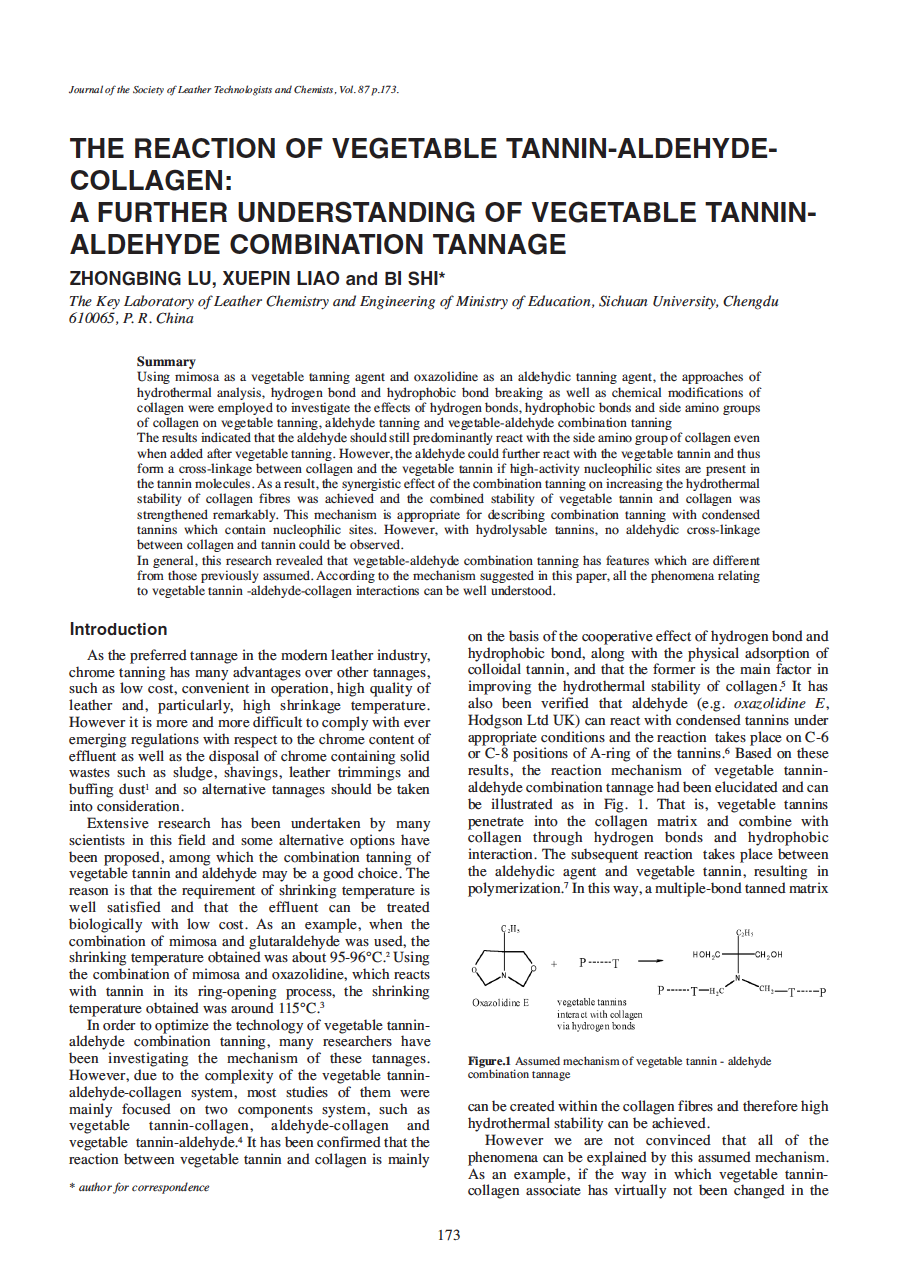
Using mimosa as a vegetable tanning agent and oxazolidine as an aldehydic tanning agent, the approaches of hydrothermal analysis, hydrogen bond and hydrophobic bond breaking as well as chemical modifications of collagen were employed to investigate the effects of hydrogen bonds, hydrophobic bonds and side amino groups of collagen on vegetable tanning, aldehyde tanning and vegetable-aldehyde combination tanning The results indicated that the aldehyde should still predominantly react with the side amino group of collagen even when added after vegetable tanning. However, the aldehyde could further react with the vegetable tannin and thus form a cross-linkage between collagen and the vegetable tannin if high-activity nucleophilic sites are present in the tannin molecules. As a result, the synergistic effect of the combination tanning on increasing the hydrothermal stability of collagen fibres was achieved and the combined stability of vegetable tannin and collagen was strengthened remarkably. This mechanism is appropriate for describing combination tanning with condensed tannins which contain nucleophilic sites. However, with hydrolysable tannins, no aldehydic cross-linkage between collagen and tannin could be observed.
In general, this research revealed that vegetable-aldehyde combination tanning has features which are different from those previously assumed. According to the mechanism suggested in this paper, all the phenomena relating to vegetable tannin -aldehyde-collagen interactions can be well understood.
£20.00
Are you a member? Log in for access to the article.
Volume Number
87
Author(s)
ZHONGBING LU; XUEPIN LIAO; BI SHI
The Reaction Of Vegetable Tannin-Aldehydecollagen: A Further Understanding Of Vegetable Tanninaldehyde Combination Tannage