The Three Pot Solution For Chromium, Tannins And Solid Wastes: Recovery And Reuse Technique For Spent Semi-Chrome Liquor And Chrome Shavings
Abstract
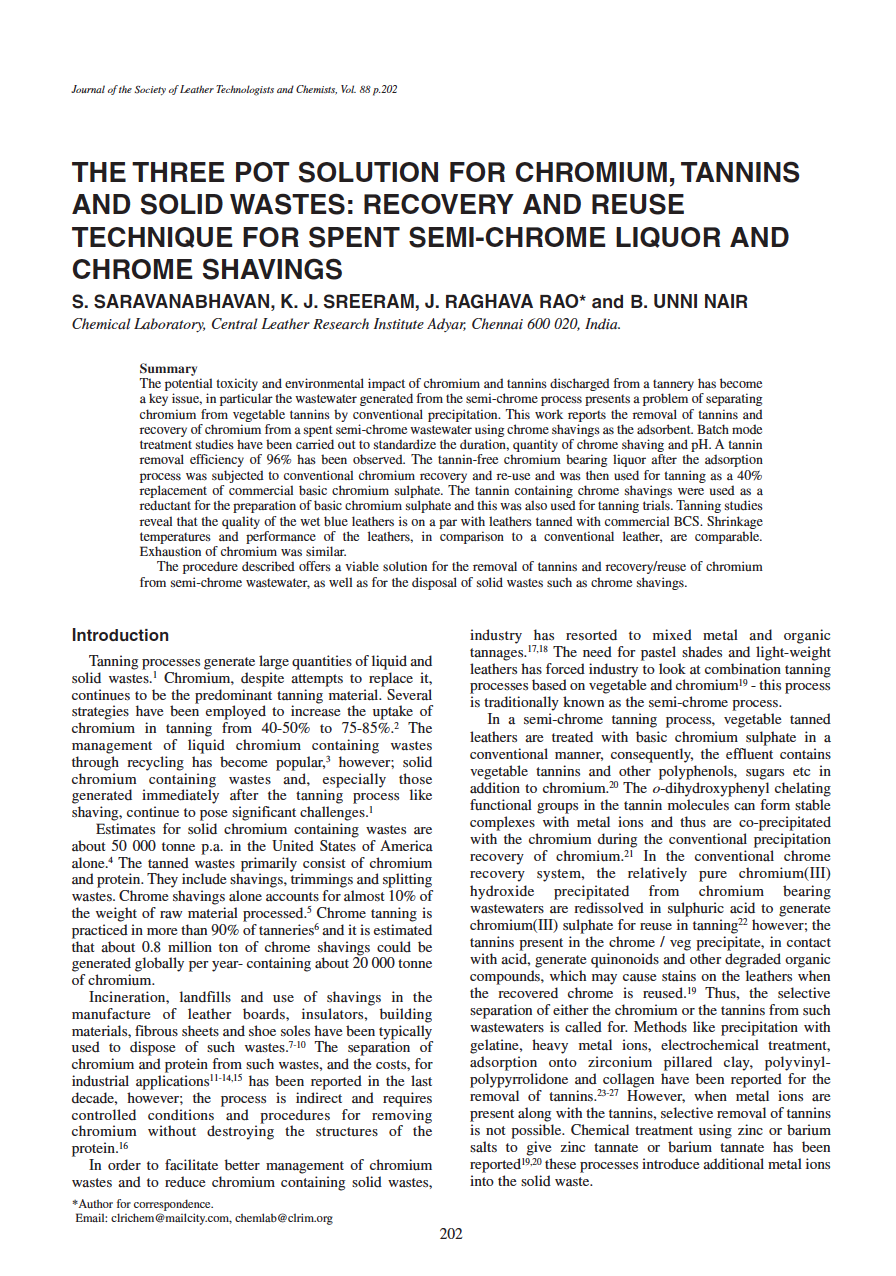
The potential toxicity and environmental impact of chromium and tannins discharged from a tannery has become a key issue, in particular the wastewater generated from the semi-chrome process presents a problem of separating chromium from vegetable tannins by conventional precipitation. This work reports the removal of tannins and recovery of chromium from a spent semi-chrome wastewater using chrome shavings as the adsorbent. Batch mode treatment studies have been carried out to standardize the duration, quantity of chrome shaving and pH. A tannin removal efficiency of 96% has been observed. The tannin-free chromium bearing liquor after the adsorption process was subjected to conventional chromium recovery and re-use and was then used for tanning as a 40% replacement of commercial basic chromium sulphate. The tannin containing chrome shavings were used as a reductant for the preparation of basic chromium sulphate and this was also used for tanning trials. Tanning studies reveal that the quality of the wet blue leathers is on a par with leathers tanned with commercial BCS. Shrinkage temperatures and performance of the leathers, in comparison to a conventional leather, are comparable. Exhaustion of chromium was similar.
The procedure described offers a viable solution for the removal of tannins and recovery/reuse of chromium from semi-chrome wastewater, as well as for the disposal of solid wastes such as chrome shavings.
£20.00
Are you a member? Log in for access to the article.
Volume Number
88
Author(s)
S. SARAVANABHAVAN; K. J. SREERAM; J. RAGHAVA RAO; B. UNNI NAIR
The Three Pot Solution For Chromium, Tannins And Solid Wastes: Recovery And Reuse Technique For Spent Semi-Chrome Liquor And Chrome Shavings
Volume Number
88
Author(s)
S. SARAVANABHAVAN; K. J. SREERAM; J. RAGHAVA RAO; B. UNNI NAIR