Unhairing Technology Involving Hair Protection Adaptation of a Recirculation Technique
Abstract
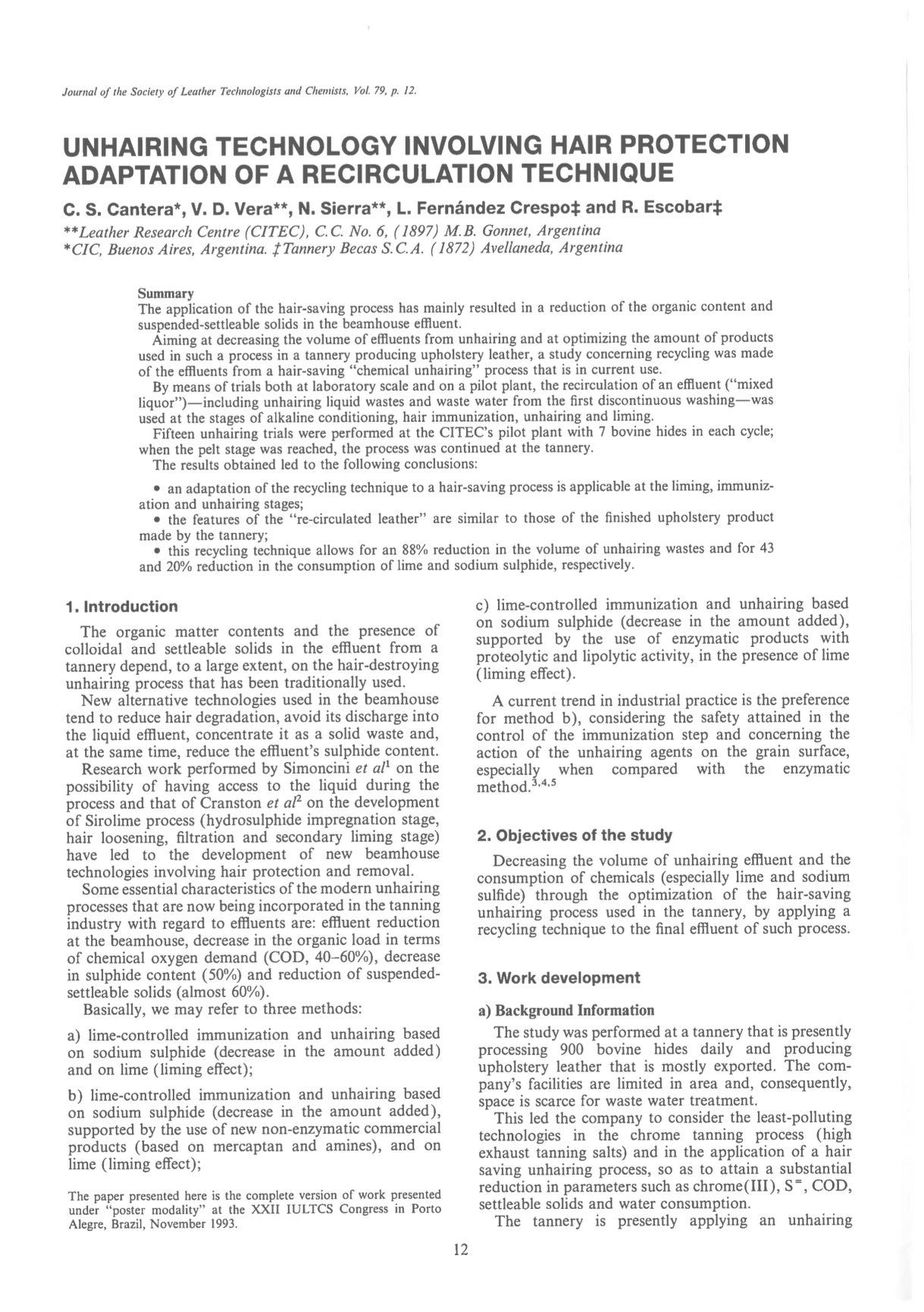
The application of the hair-saving process has mainly resulted in a reduction of the organic content and suspended-settleable solids in the beamhouse effluent. Aiming at decreasing the volume of effluents from unhairing and at optimizing the amount of products used in such a process in a tannery producing upholstery leather, a study concerning recycling was made of the effluents from a hair-saving “chemical unhairing” process that is in current use. By means of trials both at laboratory scale and on a pilot plant, the recirculation of an effluent (“mixed liquor”) – including unhairing liquid wastes and waste water from the first discontinuous washing – was used at the stages of alkaline conditioning, hair immunization, unhairing and liming. Fifteen unhairing trials were performed at the CITEC’s pilot plant with 7 bovine hides in each cycle; when the pelt stage was reached, the process was continued at the tannery.
The results obtained led to the following conclusions:
• an adaptation of the recycling technique to a hair-saving process is applicable at the liming, immunization and unhairing stages;
• the features of the “re-circulated leather” are similar to those of the finished upholstery product made by the tannery;
• this recycling technique allows for an 88% reduction in the volume of unhairing wastes and for 43 and 20% reduction in the consumption of lime and sodium sulphide, respectively.
£20.00
Are you a member? Log in for access to the article.
Volume Number
79
Author(s)
C. S. Cantera; V. D. Vera; N. Sierra; L. Fernandez Crespo; R. Escobar
Unhairing Technology Involving Hair Protection Adaptation of a Recirculation Technique
Volume Number
79
Author(s)
C. S. Cantera; V. D. Vera; N. Sierra; L. Fernandez Crespo; R. Escobar