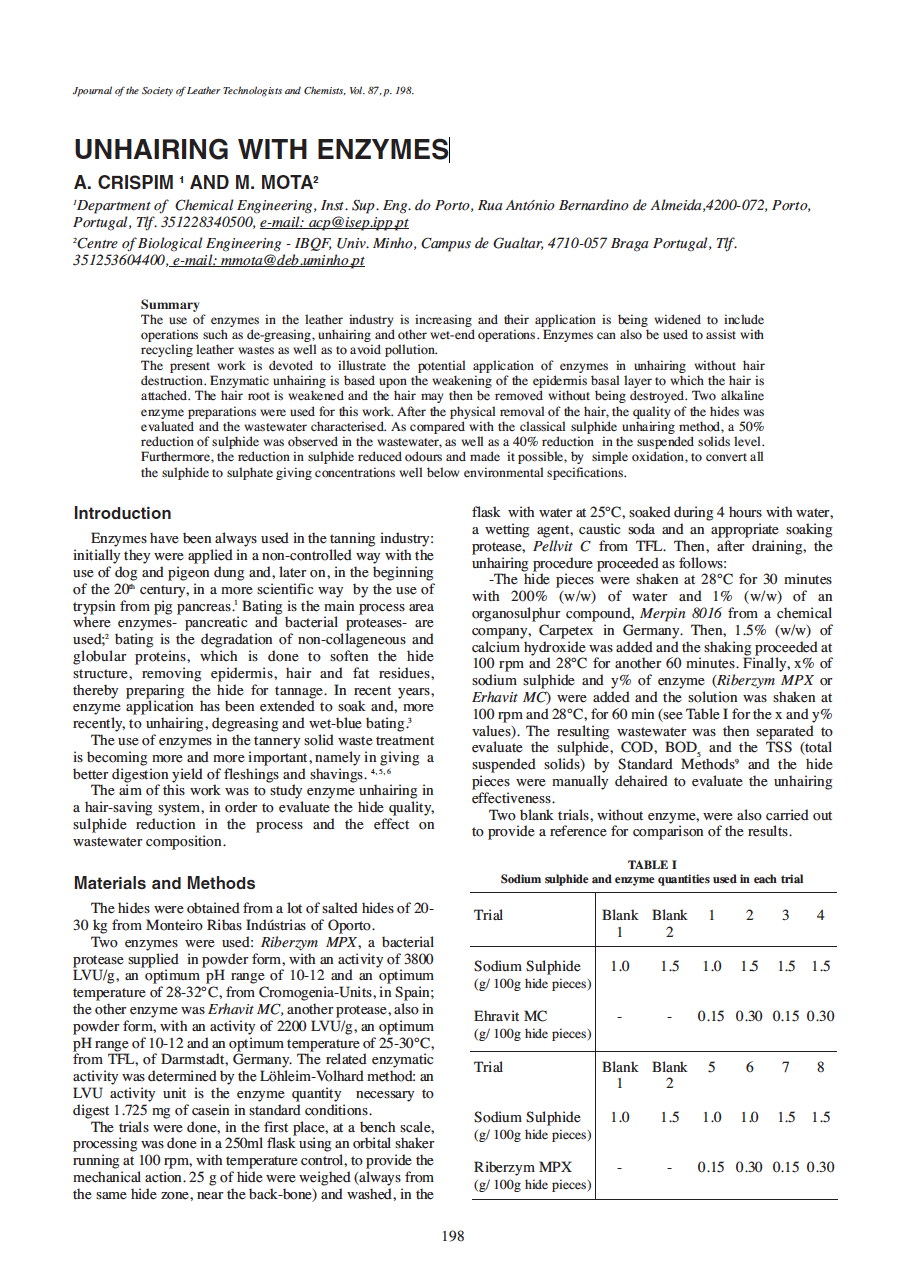
The use of enzymes in the leather industry is increasing and their application is being widened to include operations such as de-greasing, unhairing and other wet-end operations. Enzymes can also be used to assist with recycling leather wastes as well as to avoid pollution. The present work is devoted to illustrate the potential application of enzymes in unhairing without hair destruction. Enzymatic unhairing is based upon the weakening of the epidermis basal layer to which the hair is attached. The hair root is weakened and the hair may then be removed without being destroyed. Two alkaline enzyme preparations were used for this work. After the physical removal of the hair, the quality of the hides was evaluated and the wastewater characterised. As compared with the classical sulphide unhairing method, a 50% reduction of sulphide was observed in the wastewater, as well as a 40% reduction in the suspended solids level. Furthermore, the reduction in sulphide reduced odours and made it possible, by simple oxidation, to convert all the sulphide to sulphate giving concentrations well below environmental specifications.
£20.00
Are you a member? Log in for access to the article.