Use Of Ultrasound In Soaking For Improved Efficiency
Abstract
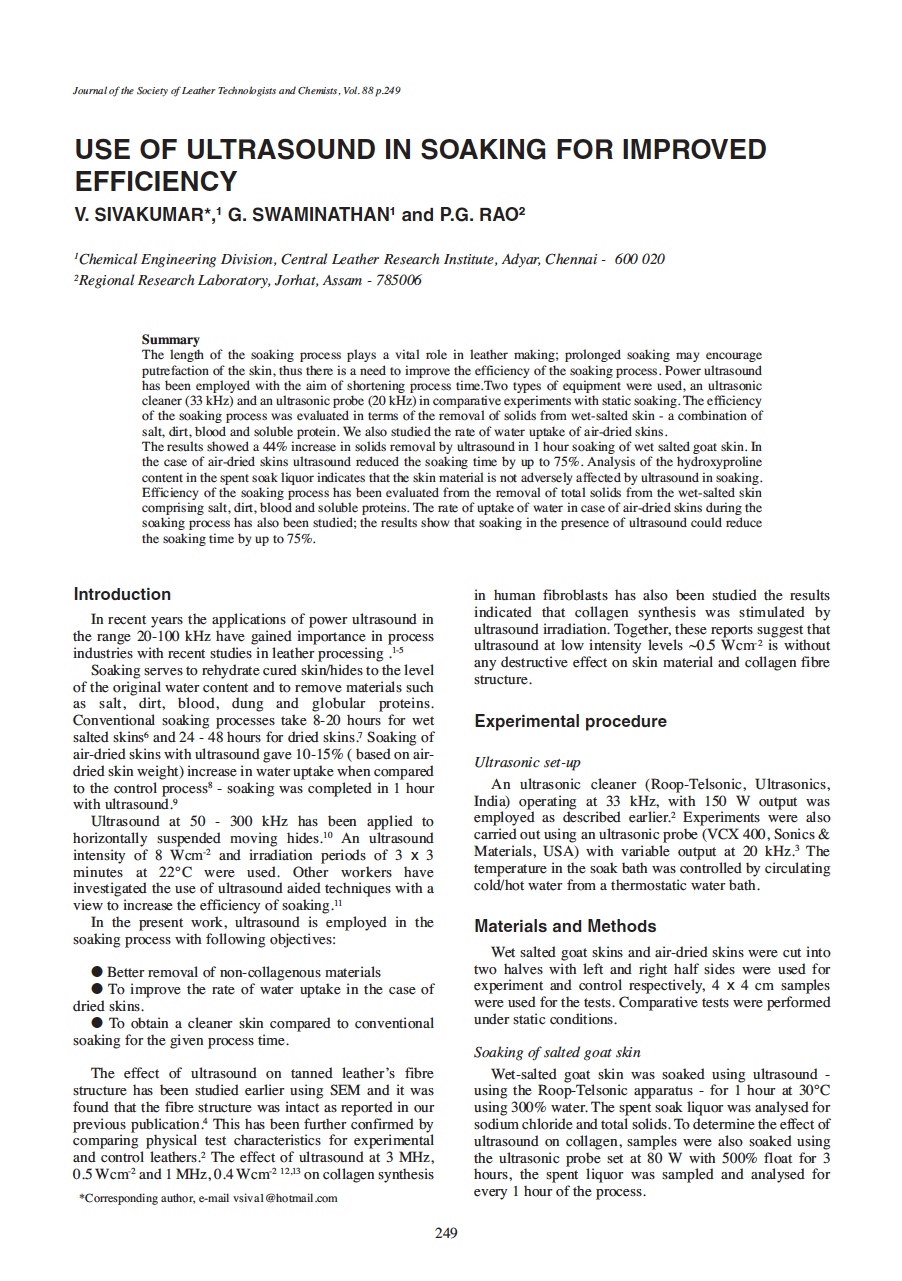
The length of the soaking process plays a vital role in leather making; prolonged soaking may encourage putrefaction of the skin, thus there is a need to improve the efficiency of the soaking process. Power ultrasound has been employed with the aim of shortening process time.Two types of equipment were used, an ultrasonic cleaner (33 kHz) and an ultrasonic probe (20 kHz) in comparative experiments with static soaking. The efficiency of the soaking process was evaluated in terms of the removal of solids from wet-salted skin – a combination of salt, dirt, blood and soluble protein. We also studied the rate of water uptake of air-dried skins. The results showed a 44% increase in solids removal by ultrasound in 1 hour soaking of wet salted goat skin. In the case of air-dried skins ultrasound reduced the soaking time by up to 75%. Analysis of the hydroxyproline content in the spent soak liquor indicates that the skin material is not adversely affected by ultrasound in soaking. Efficiency of the soaking process has been evaluated from the removal of total solids from the wet-salted skin comprising salt, dirt, blood and soluble proteins. The rate of uptake of water in case of air-dried skins during the soaking process has also been studied; the results show that soaking in the presence of ultrasound could reduce the soaking time by up to 75%.
£20.00
Are you a member? Log in for access to the article.
Volume Number
88
Author(s)
V. SIVAKUMAR; G. SWAMINATHAN; P.G. RAO
Use Of Ultrasound In Soaking For Improved Efficiency